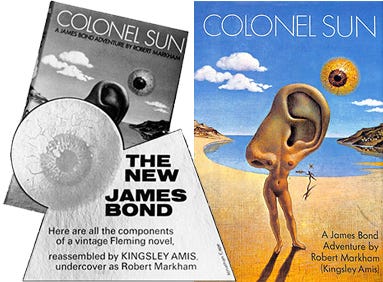
This interview was originally published in 007 Issue #15 (1984) and reprinted in the 007 MAGAZINE 40th Anniversary Issue (September 2019). With Charlie Higson’s James Bond novel KING ZERO now in bookshops we thought this was an opportune time to re-publish this definitive interview with Kingsley Amis, the original and - still! - the best ‘continuation’ author. There will be lots more from our archives about the continuation novels in the coming weeks and months here on the 007 MAGAZINE Substack…
Raymond Benson writes…
While visiting London in August 1982, to do research for my book, The James Bond Bedside Companion, I had the pleasurable opportunity to meet and speak with Kingsley Amis. Mr. Amis, of course, is an extremely well-known personality in England, and the author of several novels which could be called “classic” Lucky Jim (1954), Jake’s Thing (1978), among many others), as well as The James Bond Dossier (1965) and COLONEL SUN (1968). I met him in a small flat in the North of London. Workmen were adding something, or taking away something, to the front of his building. Despite the racket, we managed to have a fun conversation, mainly because we were simply two James Bond fans discussing something for which we both had a fondness.
Did you know Ian Fleming?
I met him only a couple of times.
I guess that was late in his life?
Oh, yes; the first time was at a party. I said to him, “Mr Fleming, it is very nice, it is very rare to meet an author to whom you can honestly say, “I’ve read all your books and I enjoy them very much.” And he said, “That’s very kind of you. Of course, you know they’re all true.” I said, “Oh?” And he said, “Oh yes! If you go to that part of Moscow that I describe in several of my works, particularly FROM RUSSIA, WITH LOVE, and you go to that building on the Sretenka Ulitsa, you will find Colonel General General Grubozaboyschikov, and all his friends – they’re all there. Oh yes.” The other time was when I let him see the typescripts of The James Bond Dossier before I sent it to the publishers, for his comments. He kindly took me out to lunch – it was nice, quite expensive – and if you’ll remember, there were quite a number of critical comments I made on the style and that sort of thing – and he had nothing to say on any of those. But he had points of accuracy he wanted to put me right about. One was that it is the Royal and Ancient Golf Club, not the St. Andrew’s. Another was that Oddjob was sucked out of the cabin of the aircraft, not blown out. It was in that order. I think there were only three. I got them wrong, he put me right.
He seemed to accept criticism very well.
Yes.
How did The James Bond Dossier come about?
It’s in the preface to it, really. I was going to write an article. I thought the books had been very seriously misrepresented in the papers and so on, and I thought the record should be set straight. I wanted people to pay attention to what he actually wrote, not on what he didn’t write. I thought it would be a medium-sized magazine article, but I found it became a small book.
Did you have to get permission from Glidrose?
They approached me, afterwards, for the – are you talking about COLONEL SUN? I didn’t have to get permission for the Dossier, though I did inform them because it made life easier. I was able to see the original reviews – always helpful to read the original reviews. When it came to COLONEL SUN, they approached me.
That was my next question!
Yes. And I started from scratch. One of the nicest compliments I’ve ever had, I get it a lot, from strangers, mostly from the United States, who write to me, usually male, and I would guess young (in their teens); after saying nice things one said, “Can you confirm a rumour that you were shown drafts and plans of Ian Fleming’s that he left behind him when he died from which you based COLONEL SUN?” I wrote back and said, “Thank you very much, you’ve paid me a high compliment because, no, not a word of his survived. But you’re implying by saying that that you think COLONEL SUN is a worthy continuation of what Fleming wrote.”
Why did you choose to use a pseudonym?
Ah. Well, that was agreed between myself and the publisher and Glidrose. Partly for my convenience. Because it set that apart from my other works. But really, more at the time, it was considered possible that other writers might like to have a crack at it. And so it would be there for all other writers doing sequels in a few years – it would be less confusing if they all had the same pseudonym. No attempt to persuade the public that it was the same man, but it would be more convenient to market the books and so on.
How was the book received at first?
Oh, very well. Very well by the public. The reviews, at any rate, were not very friendly. But then, of course, Fleming’s reviews weren’t friendly either. Also I got a lot of accusation, as Fleming did, that the writing was fascist. “Oh, here’s another fascist.”
I felt that COLONEL SUN dealt more with politics than most of Fleming’s.
Did you?
Mainly because for the first time, Red China was in the picture…
Yes. Well that was actually for pure convenience. I certainly don’t believe that the West will get together with the Russians and team up against the Chinese. The Eastern Mediterranean. That was the place to go. I had a good friend there who knew Greece; I had a standing invitation to visit the place any time I liked. Well, this was the time I liked – it was a place where Bond had never been, and I had an expert point things out to me. Luckily, that’s very much one of Russia’s areas of interests. So it worked out in plot purposes. The Chinese were close and convenient.
I particularly liked the female character. She seemed a bit more well-drawn than Fleming’s women…
I thought it was important, I think he would have thought it was all right. It was rather nice for her to ... do a little more.
COLONEL SUN was very nasty.
(Laughs)
Is it true that Glidrose approached you again to do an update on The James Bond Dossier?
It didn’t get quite as far as that. No, that’s not my recollection of it at all. No, I’ve never thought of writing anything of any size again. It’s been 15 years of time. I don’t think I’d change my mind on anything I’ve said. All that’s happened since has been, a few articles and the like... and the films. I suppose you will say something about all that.
Have you seen the John Gardner book?
Yes.
The second one is out in America. I feel it’s a little better than the first one…
I thought the first one wasn’t good. And I think the second one ... is even worse! I’m reading it now. I’m at the point where they’re about to arrive at this fellow’s private…
…ranch?
Yes. And what has happened in between their point of arrival in New York and this point is nonsense! Absolute nonsense. He arrives with this cover, with the prints, and all that had to happen was for some very well-dressed chap to say, “Oh, my principal would very much like you to accompany us to Texas and show him your prints with no obligation. He would put you and your lovely wife up as guests.” And they go and hide in that hotel, disguising themselves, then taking the disguises off – it does no good – and is SPECTRE trying to kill him, but at the same time not trying to kill him? It’s hopelessly muddled. Isn’t it?
It works itself out. I felt the first one drew more on the films…
Yes. You know, it’s the motives – what exactly is SPECTRE trying to do? – and all that business between New York and Texas – yes, it would go quite well in a film. Because you’re not asking questions. “Oh, look, now they’re in an elevator and the elevator’s crashing – what fun!” You don’t worry about why or who’s doing it or what effect it’s going to have.
The films do that a lot…
The films do that a lot. And the girl…
Cedar?
No, in the armoury…
Oh! (Laughs) Q’ute!
(Grimaces.) That’s… terrible! The idea that Bond would have anything to do with a liberated woman is… and the idea that he would ever take a woman on as a partner is ridiculous!
And it’s his best friend’s daughter!
Of course! And the idea too that the President of the United States has so little confidence in his own intelligence agents that he would overrule them and say, “No, get someone from Great Britain – somebody who’s an expert on SPECTRE!”
James Bond!
Or whatever that is! “And we’ll let him have the daughter of one of our best CIA men.” Anyway, it’s interesting to me to… I only read OCTOPUSSY once. I happened to find it on the shelf the other day, and I had forgotten what happens in it. I read it again, and it’s definitely a different literary world. The straightforward way that story is told… every sentence is absolutely firm and clear. The Gardner book, by contrast, is very hesitant and obscure.
Much of the detail seems to be put in for the sake of putting in detail. You know what I mean?
Yes, I do know what you mean. That’s what I think myself. The description of that house in the Everglades or wherever it is… it’s hopeless! And you haven’t got what you have in the Fleming novels, in that something happens from the beginning. For instance, when Bond goes to Shrublands…
In THUNDERBALL?
Yes. You don’t see the point of that until you know… you know there will be a point as soon as Bond discovers the meaning of that tattoo on the SPECTRE fellow’s arm.
Your COLONEL SUN certainly started off with a bang!
Yes. Well, you see, it’s certainly not important to have a car chase on page two, but there should be something right from the word go.
I felt COLONEL SUN might have been the most violent of the books…
Yes. And the torture scene – a lot of people objected to that.
It was the worst one since CASINO ROYALE.
Yes.
Was that intentional?
Well, I thought if we’re going to have a torture scene it’s not going to be like any other one we’ve had before. So, I got hold of my doctor – he actually appears in the book – Dr. Allison – you remember when Bond’s wandering around in the park and is taken to the police station? And the police doctor who treats him? That was my doctor, Dr. Allison. Anyway, I said to him, “Look, fix me up with a good torture.” He said, “Right! Good, we’ll do it straight away.” I said, “Now forget all about his testicles, we’ve done that, we’ve been through that. We’ve got to start somewhere else.” And he said, “Well, it’s got to be inside the head.” He thought of it in the space of 15 seconds. “That’s where you start, that’s what people are really afraid of - what they can’t see.” This was proven correct.
I also liked the way you had the villain call him “James” rather than the obligatory “Mister Bond.”
Oh yes! (Laughs) I forgot about that. You know, there’s one serious flaw in COLONEL SUN that I didn’t know about until years later. And that is that a mortar bomb would not explode when dropped on the ground.
Really?
I was totally surprised. Someone who had been an officer in our army said, “That’s a very ingenious contraption developed in the war, but you know, a mortar bomb, simply in its case, is harmless.” What are you going to do if someone has a rough landing in an airplane? You can’t have the damn things going off. They’re harmless. They’re armed in the nose and must hit their target after they are fired.
Well, I didn’t know.
Now you do. It really annoyed me.
You think a film will ever be made using the title?
The filmmakers have for some reason shown no interest in it.
What do you think of the films?
Well, the last one I saw was an incomplete print of The Spy Who Loved Me. (Grimaces)
I get even more annoyed when I see that people actually think it’s funny!
They’ve gone too far into slapstick, to be sure…
Well, it affects the whole thing. I can’t think of the right film… early on we have a parachute jump on skis, and the parachute opens up to be…
…a Union Jack.
(Loud exhale accompanied by a sour grimace.) …and the whole idea that he’s up there, having no idea that there’s an enemy agent within a thousand miles, and of course he’d carry a parachute! And the mothership in whatever it is… the one with the submarines…
That’s The Spy Who Loved Me…
Is that the same one?
They’re all the same.
Yes. Well, that control room has bullet-proof blinds, but also holes where you can point the guns through. “What are those holes for?” “Oh, well that’s in case we take our people prisoner and they all escape! We can shoot at them through these holes!!”
I guess you’ve heard the rumour that Sean Connery is doing a new film?
I’ve been wondering about the truth in all that.
Supposedly he’s going to do it at age 60, coerced out of retirement.
That reminds me of an idea for a short story I had that would round off the whole saga. It was the kind of story you put in a Christmas annual. This is the aged Commander Bond, age 70 probably, on holiday in Switzerland. He doesn’t ski anymore. A very beautiful young girl, whose father is a United States senator, comes up to him and says, “My father is in danger. Sinister Colonel-General Monarvsky of the KGB has kidnapped him. Please help me. You’re the only person I can ask. And I’ll do anything if you help me.” So Bond says, “Well… it’s a bit late for anything, I think… BUT… I’ll help you.” And of course, at the end, the Russian general and Commander Bond are falling over a waterfall in each other’s arms. When I told this to Glidrose, they all went white! (In a slow, menacing whisper). “Don’t you dare print this! Not a word of it!” I’m exaggerating, of course, but needless to say, they didn’t find it in their favour at all…
Click here for a fully illustrated version of this article
Click on this text to see and order from our range of collectible hardback books