First published in the UK in April 1953, Ian Fleming’s James Bond novels were very popular in the UK and across the Commonwealth, but by the early 1960s had yet to become widely read in the USA. It was not until March 1961 when US magazine LIFE published the list of President John F. Kennedy’s 10 favourite books that this suddenly changed. The inclusion of FROM RUSSIA, WITH LOVE at number nine on the list increased Ian Fleming’s readership in the USA overnight, and his novels then started to be reprinted in paperback with great success by Signet Books. Always with an eye on taking Bond to the big screen, in late 1960 Ian Fleming met with Harry Saltzman, the UK based Canadian producer of Look Back In Anger (1959), Saturday Night And Sunday Morning (1960) and The Entertainer (1960). Saltzman took out a six-month option on the James Bond novels (with the exception of CASINO ROYALE – the screen rights had been sold in 1954) and then feverishly went to work trying to find a financial backer for the first film. Unbeknownst to Saltzman, UK-based American producer Albert R. Broccoli had also been interested in filming the James Bond novels, and the pair were introduced via their mutual friend screenwriter Wolf Mankowitz.
With time running out on Saltzman’s option, the producers entered into a reluctant partnership and agreed to make the films together. After Broccoli’s home studio Columbia turned them down the pair flew to New York and met with United Artists executives on June 21, 1961. After a very short meeting UA agreed to finance the first film for a budget of $1 million, and the deal was then announced in industry journals and by the press worldwide on June 29, 1961. The first film at this stage was either going to be based on DIAMONDS ARE FOREVER or DR. NO and would be made by Saltzman’s own company Lowndes Productions, instead of Broccoli’s Warwick Films. As pre-production work on the first project began, a new company called EON Productions was formed to produce the films, and for tax purposes a second company DANJAQ (the first three initials of Broccoli & Saltzman's respective wives’ names - Dana and Jacqueline) responsible for the copyright and trademarks to the characters, elements, and other material related to James Bond on screen. Saltzman's Canadian citizenship allowed them to base DANJAQ in Switzerland.
Ian Fleming’s most recent novel, THUNDERBALL (1961), was also considered as the first film, but the title quickly became the the subject of a lengthy court battle between the author and Irish filmmaker Kevin McClory. A new screenplay had even been written by Broccoli’s frequent collaborator Richard Maibaum and delivered to EON Productions on August 18, 1961, but shelved when he began work on Dr. No. Richard Maibaum's original 1961 Thunderball screenplay is barely recognisable as the style of James Bond scripts that would follow. Ian Fleming's 1958 novel DR. NO had itself been based upon a script written by the author for a proposed US TV series, to be called Commander Jamaica. Four of the short stories in the FOR YOUR EYES ONLY anthology (1960) had also been based on scripts for this proposed TV series. Harry Saltzman entrusted Johanna Harwood with the adaptation of DR. NO, although he had originally approached acclaimed TV writer Nigel Kneale (1922-2006), with whom he had recently collaborated on several Woodfall Productions, but the mercurial Manxman declined the offer. Broccoli’s friend Wolf Mankowitz also delivered a 102-page draft that included the idea of Doctor No being the name of the villain’s pet monkey! Mankowitz then stepped away not wishing to take any screen credit on the project. The producers wanted to remain close to Fleming’s original so far as was possible. The final screenplay was based on elements from all adaptations, and ultimately credited to Richard Maibaum, Johanna Harwood and English author John Evan Weston-Davies – known as Berkely Mather. Harwood stayed with EON Productions and co-wrote the screenplay to Call Me Bwana (1963) with Richard Maibaum, and then adapted FROM RUSSIA, WITH LOVE and GOLDFINGER for the screen, although would be uncredited on the latter together with Berkely Mather, who had written the second draft.
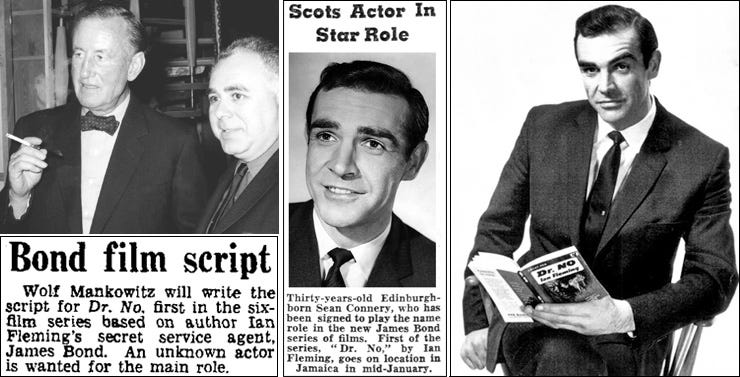
Also involved in the production of Dr. No from day one as an associate producer was Albert R. Broccoli’s frequent Warwick Films collaborator, Stanley Sopel. Many directors were originally considered including Guy Hamilton (who would later direct four James Bond films from 1964-1974), Ken Hughes, Val Guest (who would both direct segments of Casino Royale in 1967) and Bryan Forbes (1926-2013). Eventually the job went to another of ‘Cubby’ Broccoli’s friends and Warwick Films collaborators, Terence Young, who signed his contract on October 15, 1961, although Harry Saltzman and United Artists were not convinced he was the right choice as director, as he was well-known for going over schedule and over budget. The financier and distributor were also not convinced that Saltzman & Broccoli’s choice of actor to play James Bond was right either - however, after a lengthy search they had both agreed that Sean Connery was the man for the job, and offered him the role that would change his life forever! On November 3, 1961, it was announced in the press that 30-year-old Scottish actor Sean Connery had been signed to play Ian Fleming’s secret agent James Bond in a new series of films, and that shooting on Dr. No would begin in Jamaica in mid-January 1962.
Although Sean Connery had refused to take part in a formal screen test, he did agree to play opposite several actresses trying for the role of Miss Taro in a day of tests directed by Terence Young at Pinewood Studios on Thursday December 21, 1961. The four actresses testing were Talitha Pol (1940-1971) the Dutch model and Sixties fashion icon who is best-remembered for becoming the second wife of John Paul Getty Jr. in 1966; Tina Margo [listed on the call-sheet as Lina]; Violette Marceau and Zena Marshall (1926-2009) - who would ultimately secure the role. It was these tests that finally convinced United Artists that Connery was the right choice after all. Among those testing for the role of Honey Ryder was 19-year-old actress Gabriella Licudi (1941-2022), who would later play the small role of Eliza (one of M’s many daughters) in Casino Royale (1967). The sequence chosen for the test was from the scene by the waterfall on Crab Key Island when Honey tells Bond (who is cleaning his Walther pistol with a rag) that Doctor No killed her father. The scene was filmed on a beach set of rocks with a sky backing. Although Ted Moore (1914-1987) was hired as cinematographer on Dr. No the lighting cameraman for the day of tests was Geoffrey Unsworth (1914-1977), later the celebrated director of photography on Stanley Kubrick’s 2001: A Space Odyssey (1968), Bob Fosse’s Cabaret (1972) [for which he won an Academy Award], Sidney Lumet’s Murder On The Orient Express (1974), Richard Attenborough’s A Bridge Too Far (1977), Richard Donner’s Superman The Movie (1978) [the film is dedicated to Unsworth]. Unsworth ended his career with Roman Polanski’s Tess (1979), which earned him a second Academy Award. Geoffrey Unsworth died of a heart attack at the age of 64 during filming in France, with the Oscar presented posthumously and shared with cinematographer Ghislain Cloquet (1924-1981), who finished the film.
Ursula Andress, who played Honey in Dr. No, was not cast until shooting had already begun in Jamaica, and she was offered the role without ever meeting the producers beforehand. Rounding out the cast was American actor Joseph Wiseman as the titular villain; Jack Lord as CIA agent Felix Leiter; and Canadian-born actress Lois Maxwell as Miss Moneypenny, who had originally been considered for the part of Sylvia Trench (played in the film by Eunice Gayson) but wisely chose the recurring character of M’s secretary – a role she would play for the next 23 years. To play Bond’s boss, veteran British character actor Bernard Lee was signed to the production just a day before studio filming began. Lee was probably the best-known of all the cast members at the time, and explains why his name appears with an ‘also starring’ credit on the film posters, together with the principal cast. Lee went on to play M in the next 10 films in the series until his death in 1980.
On December 18, 1961, Film Finances Inc. (the UK’s leading completion bond company) borrowed £325,000 ($1 million) from Bank of America, and production formally began on the first James Bond film. United Artists had only agreed to back Saltzman & Broccoli’s first joint venture on the condition that their company, EON Productions, had a completion guarantee with Film Finances Inc. The arrangement was a way of UA assuring itself there would be some degree of control over a production that would be far from its own doorstep. Out of the £325,000 budget over one third was already taken up with the salaries of the cast and crew. By far the largest payment was to Ian Fleming, who received £35,715 for the story rights to DR. NO (then $100,000 per film and also 2.5% of the net profits); director Terence Young received £15,000 - plus £2,500 expenses for his 26-weeks work on the film. Co-producers Harry Saltzman & Albert R. Broccoli received £14,286 each (although their deal with United Artists also gave them a 50% share in the profits of the film after UA had recouped their investment). Surprisingly, Wolf Mankowitz, who withdrew from the project was paid £7,000 for his contribution to the screenplay, compared with £5,100 for Richard Maibaum and £1,000 for Berkely Mather. Johanna Harwood who had originally adapted the novel received just £300. On the acting front Sean Connery was paid £6,000 for his debut as James Bond; with Joseph Wiseman earning £5,382, and Jack Lord £2,857. The highest- paid technicians were production manager L. C. Rudkin £2,849; associate producer Stanley Sopel £2,400, and director of photography Ted Moore £1,312.
Ursula Andress received £1,500 for her iconic performance as Honey Ryder, with the same amount being paid to Anthony Dawson in the much smaller role of Professor Dent. Dawson, a friend of director Terence Young, would return to the series in From Russia With Love (1963) and Thunderball (1965) playing the hands and body of Ernst Stavro Blofeld, with the character’s voice provided by Eric Pohlmann in both films. Anthony Dawson would also appear as Colonel Klebb in screen-tests filmed at Pinewood Studios during February 1963 opposite the various actresses trying out for the role of Tatiana Romanova in From Russia With Love (1963). Eunice Gayson was paid £300 for three days’ work as Sylvia Trench, with Bernard Lee receiving £250 for his two days’ work as M, and Lois Maxwell earning £200 for her two days as Miss Moneypenny - in addition to providing her own costume for the film. Peter Burton received £50 for his one-scene performance as Major Boothroyd, filmed at Pinewood Studios on February 26th, 1962. For the role of Bond’s Jamaican ally, Quarrel, American-born John Kitzmiller was paid £750. Kitzmiller (misspelled Kitzmuller in the end credits) made an estimated 40 European films and achieved great fame in 1957, as the first black actor to win a Best Actor Award at the Cannes Film Festival for his role in the Yugoslavian (Slovenian) film Valley of Peace. Ian Fleming himself had favoured British actor Paul Danquah (1925-2015) for the role of Quarrel, following his breakthrough performance in A Taste Of Honey (1961). The author and actor had met several times whilst Danquah was studying law in the UK. Ironically, A Taste Of Honey was a film that Harry Saltzman had tried to set up at Woodfall Films, but left the production after a fall out with the other founders of the influential British ‘New Wave’ Company. ‘Cubby’ Broccoli had wanted Bahamian-born Earl Cameron for Quarrel, who would later play the similar role of Pinder in Thunderball (1965).
Production Designer Ken Adam was paid £2,563 for his remarkable contribution to the film. Working at Pinewood Studios whilst the crew were location shooting in Jamaica, Adam designed and oversaw construction of the interior sets for Dr. No at an estimated cost of £25,000. Additionally, EON Productions had spent at least £14,500 to rent the space required at Pinewood for the studio work, which began on February 26 and ended on April 26, 1962.
With the key components now in place, director Terence Young and star Sean Connery flew to Jamaica a week before the rest of the crew to soak up the Caribbean atmosphere, staying at the Courtleigh Manor Hotel, which served as the base of operations for the production (and the exterior of Bond’s hotel in the film). Action arranger Bob Simmons (who earned £400 for his work on the film - plus additional payments for particular stunts) also went on ahead in order to prepare Sean Connery for the gruelling physical shoot. On Sunday January 14, 1962, the rest of the cast and crew required for location filming flew from London to Palisadoes Airport on a specially chartered Britannia 312 at a cost of £5,000. Composer Monty Norman (and his then-wife Diana Coupland) was also among those invited to accompany the crew in order to get inspiration for the music score, after being signed to Dr. No following the closure (after just 44 performances) of his 1961 Music-Hall show Belle (or The Ballad of Doctor Crippen), co-written with Wolf Mankowitz. One of the financial investors of Belle was Albert R. Broccoli, who despite the show’s critical and commercial flop had promised to work with Monty Norman again.
Shooting on Dr. No began at Palisadoes Airport on Tuesday January 16, 1962, where the scenes of Sean Connery as James Bond being photographed by ‘freelance’, Marguerite LeWars (Miss Jamaica 1961) were filmed. The character of the girl photographer appeared in the Ian Fleming novel DR. NO as Annabel Chung, but was not named in the film. In the main titles her billing reads ‘Margaret Le Wars’, but the end credits she is correctly listed as Marguerite LeWars. Work continued throughout the day, but progress was slow as the crew were trying to film in an operational airport, which resulted in many delays as passengers arrived and departed. Jack Lord arrived late at the location and his scenes were rearranged due to the position of the sun. At the end of day once the production had completed eight camera setups it resulted in one-minute and 56 seconds of useable footage. At 5.40pm the production was already half-a-day behind schedule. The vehicles used in the airport scene (Leiter’s car and two taxis) were arranged for by location manager Chris Blackwell. Born in England, Blackwell moved to Jamaica with his parents soon after his birth in 1937. His mother Blanche was a close friend and sometime mistress of Ian Fleming, and with her husband Joseph had provided the funding to enable Chris Blackwell to form Island Records in 1958. In 1976 Chris Blackwell purchased Ian Fleming’s former Jamaican home ‘Goldeneye’ from reggae musician Bob Marley, and turned the estate into a luxury hotel.
On January 23, 1962, production manager L.C. Rudkin [Leonard Cathrow] (1908-1981) sent a memorandum to associate producer Stanley Sopel detailing the payments to be made for the various vehicles used during filming. A limousine used to transport cast members to the airport was owned by a Geoffrey Taylor, who was paid for three days use at £5 per day. Additionally he was paid £40 for damage to the car. The Sunbeam Alpine driven by Sean Connery was owned by Jennifer Jackson, who was paid £10 per day. The car had been used for two days filming at the time of the memo, but was likely to be used several times more. The production also hired a Cadillac for BP plates, but this was later changed to the Chevrolet Bel Air (driven by Reggie Carter and Sean Connery) seen in the film (although the insert shot of the speedometer is from a 1957 Ford!). The Cadillac was owned by Keith Roberts of Federal Motors in Kingston who received £10, although the car was not used. The production also hired a various assortment of canoes and catamarans for use in the film, or as camera platforms. Mr. A.L. Hendry of Kingston provided the motorboat used by Bond and Honey as they escape from Crab Key, and Quarrel's canoe at a cost of £30 per week. The boat that takes Professor Dent to Crab Key was owned by Gary Potter, who received £35 per day. Other vessels were hired as camera boats, in addition to the HMS Troutbridge Motor Cutter and a detachment of sailors who transport Felix Leiter (Jack Lord) to rescue Bond at the end of the film.
On Wednesday January 17, 1962 production moved to the Port Royal Road to capture Bond’s fight with the chauffeur Mr. Jones (played by Reggie Carter), who is an agent of the as yet unseen Doctor No. Stunt arranger Bob Simmons doubled for Carter. Production progressed with the meeting between Bond and Quarrel on Thursday January 18th, and shots required for later in the film where the two men are in a boat on the open sea as they travel to Doctor No’s island – Crab Key. These scenes were filmed over a period of three days with many shots played ‘day for night’. Several interior scenes scheduled to be filmed in Jamaica could not be completed due to ongoing weather delays. Production Designer Ken Adam was therefore sent back to England to design appropriate sets that could be used when the crew returned after location filming. Art Director Syd Cain stayed behind in Jamaica to deal with the remaining locations; his contribution to the film was sadly uncredited due to main title designer Maurice Binder accidentally omitting Cain’s name from the credits. As compensation co-producer ‘Cubby’ Broccoli gifted Cain a solid gold pen, as it would have cost too much to re-create the titles. Cain would go on to become overall Production Designer on From Russia With Love (1963) [credited as Art Director], On Her Majesty’s Secret Service (1969) and Live And Let Die (1973) – finishing his distinguished Bond career as storyboard artist on GoldenEye (1995).
The Morgan's Harbour Hotel at Port Royal in Kingston served as the location of Puss-Feller’s bar over three days beginning Monday January 22, 1962. Chris Blackwell had introduced Monty Norman to local band-leader Byron Lee, who with his group The Dragonaires performed ‘Jump Up’ in Dr. No. The backing track used for playback on location was recorded on Wednesday January 24, 1962, at the Federal Recording Studio in Kingston under the supervision of Monty Norman and arranger Carlos Malcolm. The rest of the month of January was taken up with the other scenes set in and around Kingston, including Strangways house and the murder of his secretary Mary (played by Dolores Keator), who owned the house at 5 Kinsale Avenue where the filming took place. Two different houses owned by Richard and Dolores Keator on Kinsale Avenue were used for exterior and interior filming. The Liguanea Club in the heart of Kingston served as the exterior of the fictional Queen’s Club; whilst the façade of King's House, residence of the Governor General of Jamaica, was seen as the non-fictional Government House. The location saw the introduction of Bond’s first throwaway line, “Sergeant, make sure he doesn't get away.” - which set the tone for the tongue-in-cheek humour of Dr. No, and was an unscripted invention on the part of Sean Connery and Terence Young.
Ursula Andress arrived in Jamaica on January 29, 1962, as the first block of location shooting came to an end. She then filmed her first scene with Sean Connery - actually the final sequence of the film when Bond and Honey kiss in a boat after escaping from Doctor No’s island. A close-up of the kiss was later filmed at Pinewood Studios. On February 6, 1962, the production moved its base to the Carib Ochos Rios Hotel on Jamaica’s north shore. Monty Norman had already begun recording several of the songs featured in the film while he was still in Jamaica; among these was ‘Under The Mango Tree’, which was to be sung by Ursula Andress as Honey Ryder as she makes her iconic entrance from the sea - filmed on February 8, 1962. Andress, by her own admission, couldn’t carry a tune, and her vocal performance (including the singing) was re-voiced by Nikki (Monica) van der Zyl during post-production. ‘Cubby’ Broccoli famously noted in his autobiography, When The Snow Melts, that the Swiss-born actress had ‘a voice like a Dutch comic’!
Terence Young recalled that during the filming of the scene four men were seen walking up the beach, ruining the shot. He yelled at them to get down and then forgot about them. After the shot was completed assistant director Clive Reed rounded up the men, who turned out to be James Bond creator Ian Fleming, his friend playwright Noel Coward, poet and novelist Stephen Spender, and writer Peter Quennell. This was the first time Ian Fleming visited the set of a James Bond film and was so taken with Ursula Andress that he included mention of her in his next novel, ON HER MAJESTY’S SECRET SERVICE (1963). The crew then moved to the Vanzie Swamp in Falmouth to film the sequence involving Doctor No’s ‘Dragon’ Tank. The working vehicle was actually a marsh wagon transported from the Florida Everglades, augmented by a Ken Adam design, and modified by Syd Cain on location in Jamaica. Over three days in the stinking swamp from February 13, 1962, cast and crew endured very unpleasant conditions in order to film the sequence. The crew captured the scenes for the exterior of Doctor No’s Crab Key hideaway at Reynold’s Bauxite Docks, and this site would be recreated in miniature, and then destroyed back at Pinewood Studios on the Paddock Tank by Special Effects Supervisor Frank George.
During the filming in Jamaica, American glamour photographer Bunny Yeager was present on location and used the time in between scenes to capture a series of iconic stills of Ursula Andress for use in the publicity campaign for the film. In February 1962, Yeager had been contacted unexpectedly by United Artist’s National Publicity Director, Samuel J. Friedman, who asked her if she was able to leave for Ocho Rios via Montego Bay the next day for a three-day assignment photographing Ursula Andress – and Sean Connery. Her photographs are among the best and most famous of any taken on the Jamaican location. At Dunn’s River Falls, the scenes of Bond and Honey washing (which preceded the ‘Dragon’ sequence) were filmed on February 18th, followed three days later by shots at the Sans Souci Hotel, which stood in as the exterior of Miss Taro’s bungalow on the fictitious Magenta Drive. Interiors were later shot at Pinewood Studios. A decade later the Sans Souci Hotel in Ocho Rios would also be used as the backdrop for Baron Samedi’s nightclub floorshow performance in Live And Let Die (1973). On Thursday February 22, 1962, the production office in Jamaica closed and the cast and crew flew back to the UK the next day on a charter flight, costing another £5,000.
Studio filming began on ‘D’ Stage at Pinewood Studios on Monday February 26, 1962, with the scenes involving Sean Connery, Bernard Lee, Peter Burton and Lois Maxwell. The set constructed as M’s office was put into storage after filming had finished, and re-used in subsequent films for the next 25 years, with sections even shipped across to Paris for the filming of Moonraker (1979).
Filming continued with James Bond’s now iconic introduction on the lavish casino set designed by Ken Adam based on Les Ambassadeurs Club in London. James Bond's introduction at the chemin de fer table opposite Sylvia Trench (Eunice Gayson) was shot on March 2, 1962, with Sean Connery delivering the immortal line, “Bond. James Bond.” for the first time. Ironically, it was at Les Ambassadeurs that Harry Saltzman had first met Ian Fleming in December 1960, when he first took out the option on the novels, and later as the venue chosen for the party held after the Gala Screening of Dr. No at the London Pavilion on October 5, 1962.
During this period American actor Joseph Wiseman arrived at Pinewood Studios to start work on the film, and on March 6th underwent makeup, hair, and wardrobe tests for his transformation into the Chinese-American title character (above left). Publicity stills were photographed on the set of Miss Taro’s bungalow in between setups. Among the scenes filmed on this set was Bond’s shooting of Professor Dent, culminating in another iconic line, “That’s a Smith & Wesson. And you’ve had your six.” Several versions of the scene were filmed, but it was the first and most cold-blooded iteration that ended up in the finished film – a second bullet in Dent’s back while he lay prone on the floor was deemed too violent by the British censor.
As filming continued at Pinewood Studios in mid-March 1962, the budget was gradually running out. The sparse anteroom where Professor Dent collects the tarantula that is intended to kill the sleeping James Bond was a last-minute creation by Ken Adam, using the final £450 of his construction budget. Cleverly filmed from below to emphasise the circular vent in the ceiling, the set was dressed with just a table and chair. Anthony Dawson nervously picks up the cage containing Thomas (a Goliath bird-eating spider hired for the production at a cost of £14/10 shillings) under Doctor No’s off-screen instructions on a set that was so striking, original and imaginative that the crew all burst into spontaneous applause when the rushes were screened. A model spider made by the props department was used for publicity purposes, and later sold in auction at CHRISTIE'S for £2,990 on September 17, 1998.
Shooting of the scenes in Doctor No’s apartment began on March 13, 1962 where the first of the series’ many ‘in-jokes’ was filmed. As James Bond and Honey join Doctor No for dinner, Bond passes a portrait of The Duke of Wellington by Francisco de Goya, and does a subtle double-take when he realises the significance of the work of art. The real-life painting had famously been stolen from the National Gallery on August 12, 1961, and was still missing. The implication that Doctor No was behind the robbery had a great audience reaction when the film was first released in 1962. The circumstances behind the theft were later dramatized in the 2021 comedy-drama film The Duke.
The climactic scenes in Doctor No’s reactor room set were filmed on ‘E’ Stage at Pinewood Studios over four days from March 21, 1962. Ian Fleming also visited the set during the filming on ‘E’ Stage. Another scene filmed, but not used in the final edit, was a sequence taken directly from Ian Fleming’s source novel, involving Honey Ryder being tied up and menaced by giant King crabs. Spider crabs were caught and transported from Cornwall to Pinewood packed in ice, and then decanted into oil drums filled with fresh water - with salt added! By the next morning the majority of the crabs were dead, as it’s not possible to salinate freshwater in this way. The scene was aborted, although several stills showing Andress surrounded by the crabs have survived. Andress left the production after her final scene filmed on April 3, 1962 – a close up of the kiss with Sean Connery in the boat at the end of the film that had begun in Jamaica two months earlier.
Sean Connery and Bob Simmons then spent two days filming with the live tarantula. A Perspex sheet protected the actor, with the stunt performer bravely allowing the venomous arachnid to crawl across his body, with a little encouragement from nervous crew members. Bob Simmons repeated the scene in EON Productions next film Call Me Bwana (1963), this time doubling for Bob Hope. The comedy film spoofed the Dr. No spider scene [pictured below], and the film itself was cross-promoted in From Russia With Love (1963) – with a huge film poster seen on the exterior of assassin Krilencu’s hideout as he emerges from a secret window behind Anita Ekberg’s mouth on the poster.
TO BE CONTINUED!