

It is nearing 75 years since the publication of Ian Fleming’s first James Bond novel CASINO ROYALE. The unique literary universe created by Fleming has only fleetingly been recreated by the 007 films, mostly during the early Sean Connery films, as well as within Timothy Dalton’s two performances as Bond and sections of Daniel Craig’s debut movie Casino Royale.
There is never a bad time to revisit Fleming’s magisterial literary output and 007 MAGAZINE chief writer Luke G. Williams has done so over the past year, rereading and re-evaluating the complete Fleming oeuvre - the result of which is this 14-part article in which he ranks the Fleming books - 12 novels and 2 short story collections - in ascending order, drawing some conclusions and settling on a final ranking that may in places surprise some 007 fans…
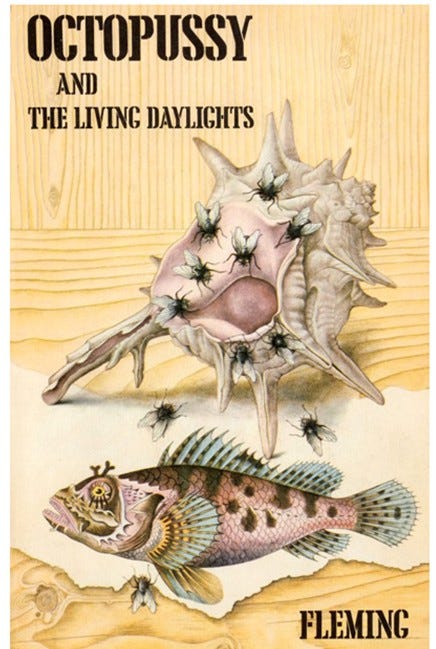
In this third instalment, Luke examines the work he has placed in 12th place - Fleming’s second and final collection of Bond short stories, OCTOPUSSY AND THE LIVING DAYLIGHTS.
Ian Fleming’s second short story collection occupies a curious position within the Bond literary canon. Published posthumously in 1966, two years after Fleming’s death, it is not really a collection in the same sense as FOR YOUR EYES ONLY was. The suspicion is that it was published primarily to keep the lucrative literary Bond bandwagon rolling.
Did Fleming write OCTOPUSSY and THE LIVING DAYLIGHTS with the intention of eventually building another collection around them? Quite possibly. Certainly the two stories share thematic links, in that they are both more concerned with morality and conscience than much of Fleming’s work.
The original Jonathan Cape first edition contained just these two stories, with THE PROPERTY OF A LADY and then 007 IN NEW YORK only being added to later editions in 1967 and 2002 respectively. When assessed as a four-story collection, as it has been for the purposes of this article, then the fact it is a random collection of material assembled after Fleming’s death, rather than a deliberately conceived volume, partly accounts for its relatively low ranking.
Overall, it is very much a book of two halves, containing two of Fleming’s finest pieces of fiction alongside two of his weakest.
OCTOPUSSY is a near masterpiece. Arguably the most autobiographical story Fleming ever wrote, centring as it does not on Bond himself but on one Major Dexter Smythe, a former British army officer now living in Jamaica. Having murdered an Austrian guide in order to steal Nazi gold at the end of the Second World War, Smythe has spent years living off the proceeds of his crime. His drinking has steadily increased, his health has deteriorated, and his wife - a sleeping pill addict - has died after an accidental overdose.
Bond arrives at Smythe’s house ‘Wavelets’ to confront the Major with the evidence of his guilt, before allowing Smythe the opportunity to determine his own fate. A personal dimension to 007’s involvement in the mission is also revealed when he explains to Smythe that the man he killed - Hannes Oberhauser - was a “wonderful man” who had taught Bond to ski as a teenager and was “something of a father to me at a time when I happened to need one".
