
By the end of production From Russia With Love was 40 days over schedule, and editor Peter Hunt had just over a month to complete his work on the film in order to be ready for the London Premiere on October 10, 1963. Perhaps Hunt’s most innovative contribution to the shaping of a sequence can be seen in the introduction of Rosa Klebb aboard Blofeld’s yacht as the main plot of the film is established. The sequence on Blofeld’s yacht was filmed very early on in production on the 10th and 11th of April, 1963 – but later rewrites to consolidate the involvement of SPECTRE made the scene no longer make sense when certain dialogue was changed. The first shot of Lenya is actually from footage used later in the scene and played in reverse. Hunt also filmed the insert shots of the Siamese fighting fish and cleverly used jump cuts to speed up the somewhat lethargic aquatic performers so they actually appeared to be fighting. Insert shots of Blofeld’s white cat reacting to the fish also breaks up the scene. The editor was also responsible for adding Eric Pohlmann’s voice as Blofeld over Anthony Dawson’s body as the unseen head of SPECTRE. With the re-ordering of scenes to make Klebb’s motives clearer, her recruitment of Tatiana Romanova and Grant as pawns in SPECTRE’s game finally focussed the storyline. The audience was completely aware of SPECTRE’s plans, but Bond is not, thereby heightening the suspense. As the set of Blofeld’s yacht had been dismantled and the rest of the cast released, Peter Hunt came up with the clever idea of making a background projection plate of Lotte Lenya from the original shoot to give the impression of the same set, and then have the actress speak new lines in front of it while covering her own image on the projected plate behind her.
Another innovation was the introduction of a pre-credit sequence to start the film with a jolt. In this instance the sequence does relate to the rest of the storyline, but in later films this would often be a standalone teaser generally used to showcase a spectacular stunt. Dr. No (1962) main title designer Maurice Binder did not work on From Russia With Love (1963) or Goldfinger (1964) due to a dispute over money, and instead noted London-based American graphic designer Robert Brownjohn was hired to create the title sequence. Working with animator Trevor Bond, and cinematographer David Watkin (with camera operator Robin Wood), Brownjohn came up with the idea of projecting the titles onto the body of a belly-dancer, and the sequence was filmed over three weekends in late August/early September. According to Robert Brownjohn’s notebooks three dancers were employed for the sequence. Actress and model Julie Mendez (1938-2013) provided most of the background body gyrations needed for the sequence; with two other performers from the famed Omar Khayyam nightclub in London (which showcased Turkish dancers) also employed for the filming. Robert Brownjohn’s notebook records one of the dancers as ‘Jamilla’, with another unnamed artiste being used only for shots of her face and upper body onto which Brownjohn projected ‘007’ to precede Sean Connery’s credit. London-born Lisa Guiraut, who appears as the Turkish belly dancer in From Russia With Love credited as ‘Leila’, had also appeared in cabaret at the Omar Khayyam.
All contributors and components required for the main title sequence for From Russia With Love (1963) were costed out by Brownjohn at £2,653. An unused shot of Sean Connery pursued by the SPECTRE helicopter in From Russia With Love was later recycled by Robert Brownjohn into the main titles of Goldfinger (1964) to accompany his own on-screen credit. Although Trevor Bond also returned to assist Robert Brownjohn on Goldfinger (1964) his work went uncredited on the film. Maurice Binder returned to design the main titles for Thunderball (1965) and the following 12 James Bond films, in addition to providing trailers and special sequences.
The theatrical trailer for From Russia With Love (1963), presumably compiled by the National Screen Service, erroneously omits Sean Connery’s name altogether! Whilst the narration by British film and television actor and voice-over artiste Tim Turner (1924-1987) reminds audiences that this “…only the second James Bond thriller could be more exciting than the first!”, any mention of its star in the caption text is missing. The same trailer was re-used for the April 1964 US release with identical narration, but by an unidentified American voice-over artiste. All the music featured in the trailer is taken from Dr. No (1962), including snatches of a few Monty Norman composed tracks not featured in the film, but included on the original soundtrack album which was not commercially available in the UK until 1965.
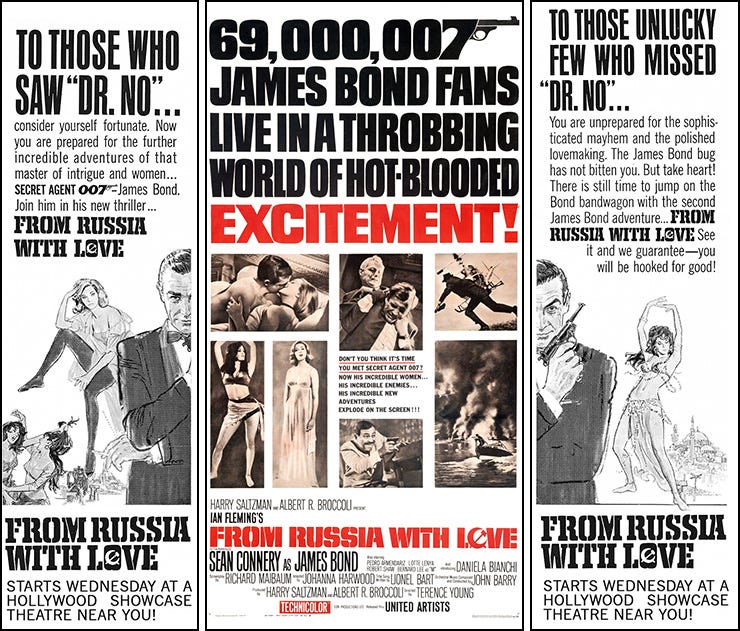
To accompany the UK release an iconic quad-crown poster designed by Eric Pulford and illustrated by Renato Fratini went through several iterations before its final rendition of Sean Connery as James Bond 007, surrounded by provocative images of women and a small vignette emphasising the exotic nature of the film, was approved. The main image of Sean Connery with a sardonic smile and holding a pistol across his chest became THE iconic image of the character that has appeared in some form or other on Bond posters ever since. However, the use of an air pistol instead of 007’s signature Walther PPK came about purely by accident. Celebrated photojournalist David Hurn (1934- ) was hired by Publicist Tom Carlile to take a series of publicity photographs of Sean Connery, Daniela Bianchi, and the other actresses in the film for use during the promotion of From Russia With Love. Unfortunately, Carlile forgot to bring the Walther PPK to the session, and Hurn being a keen amateur marksman offered his own Walther LP53 .177 air pistol for the photoshoot. Assured that the incongruous weapon could be airbrushed or altered by retouching in any posters that were based on the publicity stills, the photoshoot went ahead with the air pistol, which resulted in probably the most iconic series of stills ever taken for the James Bond film series. Unfortunately, nobody briefed the UK poster designers and the long-barrelled weapon featured as the centrepiece of the British advertising campaign, although some early concept designs do show the Walther PPK. Hurn’s Walther air pistol was originally sold in auction at CHRISTIE’S in 2001 for £14,100; and again for a world record $437,000 (£277,250) in 2010, and most recently in 2013 in the USA for $300,000. Unlike Dr. No (1962), which featured more of less the same advertising campaign on posters on both sides of the Atlantic, for the second James Bond film, alternate retouched versions of David Hurn’s stills were used by United Artists graphic designer David Chasman throughout the American campaign.
The final stages of post-production began on September 16, 1963 – where the sound, editing and music dubbing were finalised. The completed film was then sent to the Technicolor labs who delivered 75 release prints on October 7th – just one day before the press screening held at the ODEON Leicester Square. The final cut of the film had been trimmed slightly by the British Board of Film Censors in order to achieve its ‘A’ certificate. Although the Board was beginning to relax its views on sex and violence in British cinema, From Russia With Love clearly went beyond the bounds of a mainstream commercial film intended for a general audience at that time. Board Secretary John Trevelyan (1903-1986) ordered several cuts to From Russia With Love to tone down the sexual content of the film; a handful of suggestive lines between Bond and Tania were cut, in addition to several shots of the gypsy belly dancer Leila Guirat, and the subsequent fight between Martine Beswick and Aliza Gur. Treveleyan also ordered the removal of a shot of Tania walking naked towards Bond’s bed just before their first meeting (actually a double wearing a flesh colour body-stocking). This shot was the only one restored to the film when reclassified by the BBFC for home video release in 1984. The Board also suggested shortening and darkening the sequence where Bond and Tania are secretly filmed in the bridal suite of their Istanbul hotel. One more harmful trim was Grant’s line, “What a performance!” when he comments on the secretly shot reel of film as he taunts Bond on board the Orient Express. At the end of the film in the print submitted to the censor, Bond repeats the line as he looks at the film reel before tossing it into the Venetian canal. The censor’s edit here results in a clumsy jump cut which has been present in all versions of the film since 1963. The trims were noted in a memo sent to United Artists executive Robert Blumofe in January 1964 by the US censor Geoffrey Shurlock. The export prints of From Russia With Love were then conformed to the UK original release. The cut material is presumed lost. Unlike BBFC trims made to later films in the series, these cuts have never been restored. Ironically, Robert Blumofe was one of the UA executives who originally vetoed Sean Connery’s casting as James Bond in 1961!
From Russia With Love then opened at the ODEON Leicester Square in London on Thursday October 10, 1963 – with the first public screening at 12.40pm. The final performance of the day beginning at 8.20pm was designated as a ‘Gala Screening’ with many cast and crew members present, including director Terence Young and co-producers Harry Saltzman & Albert R. Broccoli. Sean Connery attended with his parents and wife, actress Diane Cilento. Co-stars Robert Shaw [with his wife, actress Mary Ure] and Daniela Bianchi were also invited to the Gala Screening and after party. James Bond author Ian Fleming also attended the screening and afterwards hosted his own private party for friends at his London home in Victoria Square. A week later Ian Fleming wrote to his friend Amherst Villiers in the USA telling him, “… the first night of ‘From Russia With Love’ was a majestic success and the queues formed all day round and round Leicester Square where it is showing at the Odeon.“ It was just the boost Fleming needed, as in another six weeks he would find himself under a different spotlight in the High Court in London, as Kevin McClory’s THUNDERBALL plagiarism case finally came to trial. Embarrassed and defeated, Ian Fleming eventually settled the case out of court with McClory winning the screen rights to the 1961 James Bond novel.From Russia With Love opened in larger towns and cities across the UK on Sunday, October 13, 1963, and proved incredibly popular, with many cinemas holding the film over for a second or third week. Due to its enormous success From Russia With Love was also shown for three weeks at the 2,400-seat ODEON Marble Arch from Thursday October 17, 1963, and became the first film ever to play simultaneously in four West End cinemas. It is no surprise that From Russia With Love subsequently became the highest-grossing British film of all time on its initial release, and broke the house record at the ODEON Leicester Square, taking £14,528 in its first week. The success of From Russia With Love prompted a re-release of Dr. No (1962) in many cinemas across the UK toward the end of 1963. Director of photography on both films Ted Moore went on to win the award for Best Cinematography (Colour) for his work on From Russia With Love at the 1964 BAFTA ceremony.
The second James Bond film opened in the USA on April 8, 1964, and went on to gross twice as much as Dr. No (1962) [released in the USA in May 1963]. Despite its troubled production, From Russia With Love (1963) has always been highly regarded by critics and fans, with Sean Connery proclaiming it was always his personal favourite. Staying close to its source material, Terence Young’s masterpiece can hold its head high among the Cold-War classics that it inspired. With its outstanding international cast, and a crew of experienced technicians, many of whom went uncredited at the time, and who have only become well-known through the continued championing of the film in 007 MAGAZINE, and by most serious Bond commentators, who still regard From Russia With Love as the high watermark of the series.
With only two Bond films to their credit Messrs Saltzman & Broccoli consolidated their success, and went on to even larger box-office grosses in the following years. Financier & distributor United Artists were equally pleased with the success of From Russia With Love and took out a full-page advertisement in the British trade magazine Kinematograph Weekly [pictured right] on May 7, 1964, congratulating the producers on their record-breaking hit. Although its creator Ian Fleming would not live to see the huge global phenomenon that the James Bond series eventually became, it is fitting that the last film he saw to completion was arguably the best of them all.
Whilst many later entries were often only nominally related to their source novel, From Russia With Love (1963) has lasted as a wholly credible standalone entry, so different from what preceded and what followed. Whilst it may be missing the outlandish set designs of Ken Adam and a main title from Maurice Binder, From Russia With Love was suitably well-served by Art Director Syd Cain, and graphic designer Robert Brownjohn. Everything came together with From Russia With Love – Sean Connery’s assured performance is arguably his most relaxed and convincing of the series, Terence Young’s confident direction sets the tone from the opening shots, Peter Hunt’s dynamic editing, and John Barry’s pulsating score ties it all together.
From Russia With Love was made and released at a time of huge cultural change in the UK. Many commentators have noted that the 1950s didn’t really end until 1963 – a year that saw many important events happen across the country in the space of 12 months. After the coldest UK winter for 200 years, April saw 70,000 marchers arriving in London from Aldermaston to demonstrate against nuclear weapons; July saw British intelligence officer and a double agent for the Soviet Union, Kim Philby given asylum in Moscow; The Great Train Robbery took place in Buckinghamshire in August, The Profumo Affair made national headlines resulting in the resignation of Prime Minister Harold MacMillan in October, and the first episode of the still-running BBC Television series Doctor Who was broadcast on November 23, 1963. But perhaps the most far-reaching world event of 1963 was the assassination of US President John F. Kennedy in Dallas on November 22nd, and the subsequent shooting of alleged assassin Lee Harvey Oswald live on television two days later.
Ironically it was JFK who had been largely responsible for the success of the James Bond novels in the USA, beginning with his endorsement of FROM RUSSIA, WITH LOVE in LIFE Magazine in 1961. Ian Fleming was a great admirer, and although the pair only met once in 1960, he subsequently sent Kennedy an autographed copy of each new novel as it was published. The James Bond connection would come full circle, when just a month before he was assassinated President Kennedy invited his friend Ben Bradlee, (1921-2014) an American journalist [who served as managing editor and later as executive editor of The Washington Post, from 1965 to 1991], to watch the second James Bond film From Russia With Love at a private screening at the White House on October 23, 1963 – four months before its US release. Within another year, Ian Fleming too would be dead at the age of 56.