007 MAGAZINE Substack chief writer Luke G. Williams argues that if Amazon don’t go back to Fleming, it’s only a matter of time before someone else does...
Ever since Daniel Craig hung up his Walther PPK five years ago, there have been waves of speculation about who will be the next James Bond and what direction the series will take.
Since February 2025, when Barbara Broccoli and Michael G. Wilson ceded creative control of the franchise to Amazon, this speculation has intensified. Right now, with ‘James Bond Day’ approaching on 5 October, Stephen Knight’s first draft of the BOND 26 screenplay complete and producer Amy Pascal having stated “I would say the end of the year is a good bet” [for the new 007 to be announced] the assumption is that any time now some substantive announcements about the 26th ‘official’ James Bond film will be made.
“We are being really, really methodical,” Pascal has also stated. “Having worked with Barbara Broccoli at the studio, I mean, Daniel Craig is a hard act to follow.
And it’s got to be something really different that is a stirring and exciting and different.”
Pascal’s insistence that the film and its lead actor must be “stirring and exciting and different” feeds into the general assumption of most commentators that, as in the past, the Bond series will move with the times by presenting the new 007 within a contemporary context.
Occasional suggestions that Amazon should look backwards and present a 1950s or 1960s-set Bond have, for the most part, been met with indifference.
However, what most commentators are missing is the most compelling reason of all why an ultra-faithful series of films based closely on Ian Fleming’s original novels is actually the best path forward.
The reason I am referring to is what I will call “the copyright clock”.
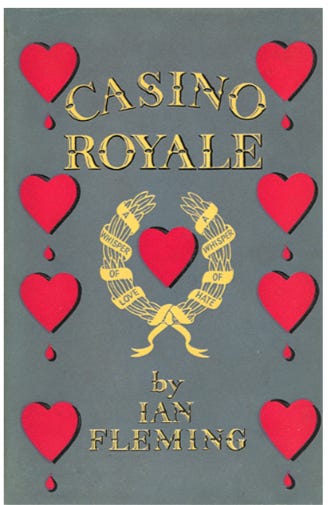
In 2035, in the UK and Europe, Fleming’s first James Bond novel CASINO ROYALE will enter the public domain. At that point, any filmmaker, studio or television network will be able to make their own adaptation, provided they do not intrude on copyright elements that were creations of EON Productions rather than present in Fleming’s original text (such as the gunbarrel opening, The James Bond Theme etc etc).
True, such a project could not be released or marketed in America, where Fleming’s novels will not start entering the public domain until 2048.
Nevertheless, the monopoly that EON has enjoyed for over 60 years and which Amazon has inherited has a visible expiry date, and the “copyright clock” countdown is ticking fast.
Amazon should view the reality of the “copyright clock” as an opportunity.
Rather than developing a contemporary 007, who may eventually have to compete with faithful adaptations of Fleming made elsewhere, Amazon could, at a strike, pre-empt any future rival productions by becoming the studio that finally adapts Fleming properly.
And let’s be honest, Fleming’s work has never been properly adapted.
Individual scenes, characters, plots and titles have been appropriated.
But EON never approached Bond with the intention of faithfully translating Fleming’s novels to the screen.
Instead, for nearly six decades, EON cherry-picked scenes, villains and concepts from the books. Even the quintet of films generally regarded as the most ‘faithful’ adaptations (Dr. No, From Russia With Love, Goldfinger, Thunderball and On Her Majesty’s Secret Service) took substantial liberties with the original texts.
By the time of No Time To Die in 2021, the cinematic 007 was – truth be told – less an adaptation than an interpretation, shaped by years of changing fashion and trends, on and off the screen.
The Fleming novels are undoubtedly a product of post-war Britain; a country that was still adjusting to the loss of empire, while being haunted by memories of two World Wars while confronting a rapidly changing world.
But a faithful series of adaptations that repositions Bond in this era would not be an empty exercise in nostalgia. Rather, they would present us with something we have never seen before in a Bond film.
Imagine a film of MOONRAKER as Fleming actually wrote it: a tense Cold War thriller centred on a single atomic rocket aimed at London.
Or CASINO ROYALE presented not as an origin story – because it isn’t one! – but as a hard-edged period thriller whose atmosphere is more John le Carré than Batman Begins or the Jason Bourne films.
The question is often asked: who exactly is James Bond in the twenty-first century?
Screenwriters agonise about whether he should smoke, whether he can make sexist remarks, or how much of his original character modern audiences will tolerate.
Pascal is right that the next Bond must be “different”.
But after 25 films, “different” no longer means changing Bond beyond recognition into a diluted twenty-first century reimagining of Fleming’s original.
Rather, it means having the confidence to rediscover what made Fleming’s work brilliant in the first place.
The longer the “copyright clock” ticks and the public domain deadline looms, the stronger the case for Fleming fidelity becomes.
A future in which multiple companies can adapt Fleming is coming whether Amazon likes it or not.
When that day arrives, audiences will inevitably compare whatever Amazon produces against adaptations that draw directly from the novels.
The smartest move Amazon could make is to establish itself now as the custodian not merely of the Bond brand, but of Ian Fleming’s James Bond.
Because if copyright history teaches us anything, it is that iconic characters eventually outgrow the creators, companies or estates that owned them.
Sherlock Holmes did.
Dracula did.
Tarzan did.
One day James Bond will too.
This is the first in a series of articles by Luke G. Williams on ‘James Bond and “the copyright clock”.
Stay tuned to the 007 MAGAZINE Substack in the coming weeks for more.
Click on this text to see and order from our range of collectible hardback books