

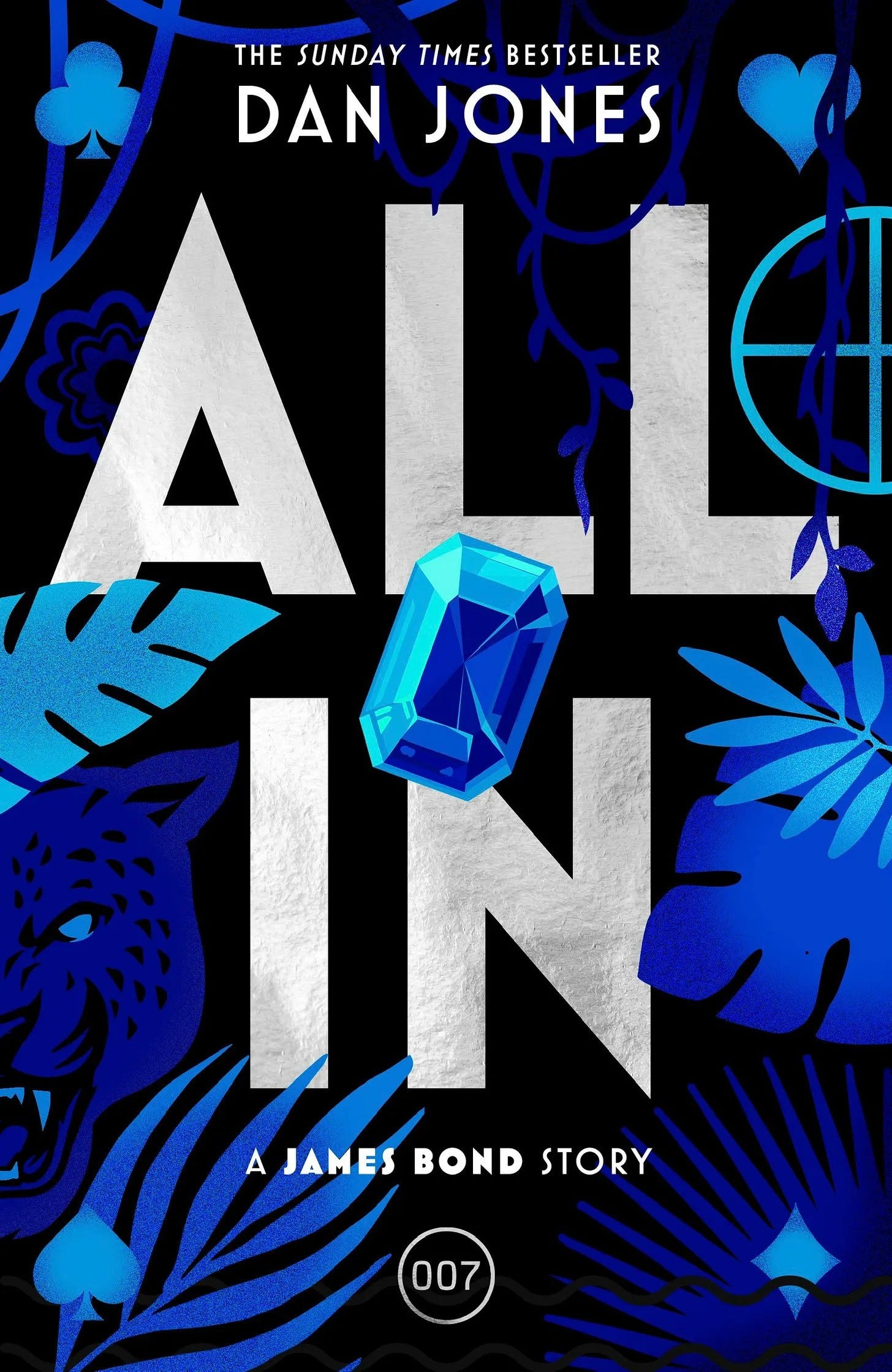
The announcement by Ian Fleming Publications – on ‘James Bond Day’ no less! – of historian Dan Jones’ forthcoming 007 novella ALL IN can be viewed in two very different ways.
Some will see it as an example of a sensible rights-holder continuing to invest in one of literature’s great franchises. Others will see it as an example of desperate literary guardians racing to create as much intellectual property as possible as the day when Ian Fleming’s work begins to enter the public domain grows ever closer.
As I argued recently in Part 1 of this series, the James Bond franchises – literary and cinematic – are not immune to the realities of what I have termed the ‘copyright clock’.
While meaningful challenges to their long held monopoly of 007 rights remains some distance away – CASINO ROYALE enters the public domain in 2035 in the UK and Europe, with Fleming’s 13 other Bond volumes to follow at yearly intervals thereafter – the direction of travel is inevitable.
Every major entertainment property eventually reaches the point where rights holders must decide whether to rely on their dwindling historic assets or build new ones.
What we are currently witnessing from Ian Fleming Publications is the literary version of this process.
Over the last two decades, the Bond literary ‘universe’ has expanded far beyond Fleming’s original novels and stories. Following continuation novels by Kingsley Amis, John Pearson, John Gardner, and Raymond Benson, we have seen Charlie Higson’s YOUNG BOND series, the MONEYPENNY DIARIES by Samantha Weinberg (writing as Kate Westbrook), and further continuation works by Sebastian Faulks, William Boyd, and Jeffery Deaver. More recently, Anthony Horowitz produced a trilogy of novels which fitted neatly into Fleming’s original timeline – the last of which – WITH A MIND TO A KILL – was published in 2022.
Since then, IFP has gone into Bond universe overdrive – we have seen: Kim Sherwood’s DOUBLE-O trilogy; Vaseem Khan’s Q MYSTERIES; the introduction of Higson’s new modern Bond timeline – established by his novella ON HIS MAJESTY’S SECRET SERVICE and now continued by KING ZERO; a spin-off work by Raymond Benson focused on Felix Leiter; and now Dan Jones’ ALL IN, which is taking the Horowitz approach and is set in the Fleming timeline after the events of DIAMONDS ARE FOREVER.
Next year, we even have a new youth-oriented Bond series beginning with the launch of M.W. Craven’s JAMES BOND AND THE SECRET AGENT ACADEMY.
There is a valid argument for what IFP are doing and the history of literary estates offers plenty of precedents.
Like Fleming’s Bond is going to do from 2035, the original Arthur Conan Doyle Sherlock Holmes stories entered the public domain in stages. In the past, and even today, despite the fact all the Holmes stories are now in the public domain, the Conan Doyle Estate have sought to maintain dominance over the character of Holmes through licensing deals and even threats of legal action.
Some publishers, filmmakers and authors wanting to use the character of Holmes or parts of the Holmes universe have concluded that it is easier – and cheaper – to pay a licence fee to the estate rather than become involved in expensive litigation, even when precedent and the rules of the public domain are clearly on their side.
With this in mind, it is worth stressing that public-domain status does not suddenly remove a literary estate’s influence, it merely changes the landscape.
Seen from this perspective, one can argue that what IFP are doing in expanding the Bond literary universe is not naked exploitation but rather prudent safeguarding.
If the company can create new characters, new stories, new settings and new continuities now, it ensures there remains a valuable body of unquestionably protected material attached to the Bond brand long after lawyers begin debating the boundaries of Fleming’s original creations.
The Double-O agents created by Kim Sherwood, for example, are wholly modern inventions. So too are many of the supporting characters, villains and organisations that populate the various continuation books. They therefore belong to IFP and will continue to do so for decades to come.
Likewise, by filling in various gaps in Fleming’s continuity, and by creating spin-off stories centred on characters such as Felix Leiter and Q, IFP are cannily leaving less territory available for others to intrude upon when the Fleming originals begin to enter the public domain.
With four ‘Bond universe’ releases this year alone, it increasingly seems like this is a coordinated publishing strategy to create as wide a range of new IP as possible.
As a result, Bond publishing no longer revolves around a single hero and a single timeline – instead it now resembles a network of interconnected properties aimed at different audiences, age groups and market segments.
Yet IFP must also be cautious. Expansion can all too easily become dilution.
One of the strengths of the Bond literary canon has always been its simplicity.
Fleming wrote twelve novels and two short-story collections, and although his work traversed genre boundaries and was often far more experimental than one usually expects from thriller fiction, the character of Bond remained at the heart of all that he wrote. Even in FROM RUSSIA, WITH LOVE, and THE SPY WHO LOVED ME, two books in which 007’s entrance was delayed, his was still the dominant presence.
What we are seeing now though from IFP increasingly resembles the franchise-building model favoured by modern entertainment companies such as Marvel: multiple protagonists, parallel timelines, spin-offs and not always interconnected continuities.
Bond fans are entitled to ask, at what point does expansion stop serving the character and merely become commercial exploitation?
We may also reasonably ask whether there is genuine demand for all these new strands or whether the creation of fresh intellectual property has become an objective in itself. Not every extension of the Bond universe automatically enriches it, for quality and quantity are not the same thing.
The ‘Copyright Clock’ is ticking inextricably, which likely explains the urgency with which IFP is moving forward into their franchise-building construction.
But while intellectual property can be manufactured, literary longevity cannot.
In decades to come, long after the lawyers, IFP and others have finished debating the ownership of Bond and his various constituent parts, readers alone will decide which of these new additions deserve a permanent place in the Bond canon, and the wider world of literature.
I suspect it won’t be many, if any at all.