

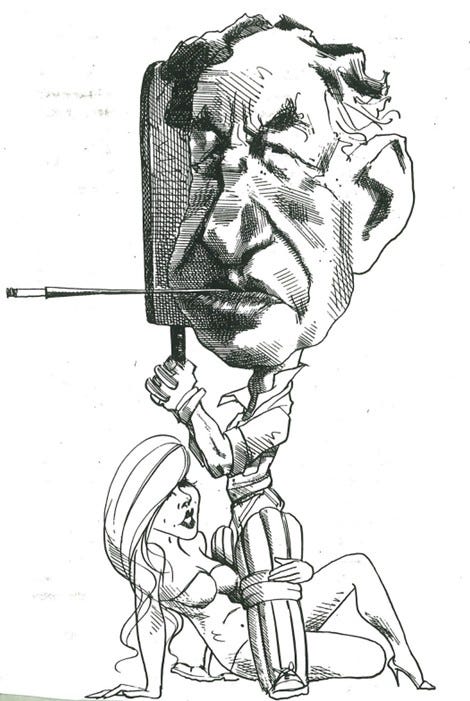
Illustration reproduced with kind permission by David Smith
Simon Barnes once sent James Bond in to bat at number seven for the England cricket team.
After a flurry of early wickets and with the team in crisis, 007 proceeded to bludgeon the Aussies into submission, score a century before lunch and seduce the girlfriend of the opposing fast bowler into the bargain.
Barnes’ short story, YOU’RE ONLY OUT ONCE, remains arguably the funniest and most affectionate Ian Fleming parody ever written. It formed part of Barnes’ wonderful 1989 collection A LA RECHERCHE DU CRICKET PERDU, a series of cricket stories written in the style of famous authors, accompanied by superlative illustrations by the artist David Smith.
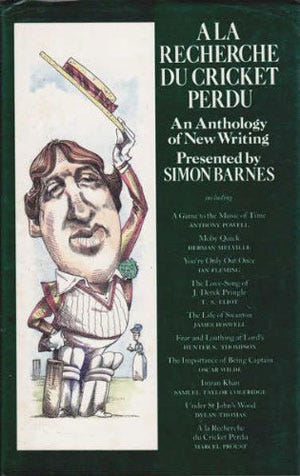
More than three decades later, Barnes still chuckles at one particular line from YOU’RE ONLY OUT ONCE when he speaks to 007 MAGAZINE Substack. “M gives Bond the number seven place in the batting order and says, ‘I’m giving you a licence to slog!’ I thought that line was quite funny at the time. Looking at it now, it’s Bazball!
“It was such a fun thing to take on,” Barnes adds of A LA RECHERCHE DU CRICKET PERDU. “As I remember it, Miles Kington was writing a column for THE TIMES around then called Moreover. He did a Raymond Chandler pastiche which was terrific. I liked it and thought, if I was to do this, who would I pastiche? Well, obviously there was [Marcel] Proust and Anthony Powell, both of whom I’m a huge fan of. Then there was [Herman] Melville and D. H. Lawrence.
“I did them mostly for my own amusement and was thinking of submitting them to THE TIMES. I made a list of writers I knew, mostly loved and thought were amenable to parody and eventually I thought: maybe there’s a book in it!
“A terrific guy called Adam Sisman agreed and said, ‘I think this is a goer.’ So we put it together. David Smith was commissioned and produced fantastic illustrations. It won the MCC Cricket Book of the Year, which was very gratifying. Nice to see there were some Proust and Fleming fans on the MCC committee!”
Barnes still laughs at one particular memory connected with the book. “I don’t normally reread my books. But one night I had a couple of drinks to celebrate publication and started reading them on the tube home and laughing out loud at my own genius! Looking at them a bit more coldly now there are half a dozen or so I blush at. But there are a few I really like.”
These include his Fleming parody which works so gloriously well because it cleverly and lovingly transfers the entire Fleming universe into the world of Test cricket. Capturing Fleming, Barnes explains, required immersion in the originals. “It was a matter of getting the vibes and the shape of it. That came partly from familiarity and partly from rereading a few of them over the course of a week or so. While doing that I’d make notes of little quirks or phrases Fleming used, thinking about directions in which to go.”

Barnes’ first line “The crack of the weapon striking home filled the room,” immediately sets the Flemingesque tone, as Bond tries out his new bat in a “windowless building that had been constructed on the Schloss-Mockenbecker principle” (a nod to the Shertel-Sachsenberg system referred to in THUNDERBALL in Fleming’s description of the Disco Volante).
Applying Fleming’s oft-used technique of flashing back to a briefing scene with M, Bond then recalls meeting his chief the previous day. Barnes’ M is a “man whose true function was known only to a handful of people in England. Outwardly he seemed an ordinary businessman, But in reality, he was chairman of the selectors, who went into battle a dozen times a season with the pick of England’s men. He used them as live chessmen, and spent them brutally when he had to.”
Asked by M what England needs, Bond quips: “Runs in the middle order, sir.” and M duly grants him a place at seven in the batting line-up and the aforementioned “licence to slog”. In an aside, Barnes tells us that M “would never have dreamed of telling Bond that he, Bond, was the best man he possessed.” Here, by the way, is a tiny but telling example of Barnes’s ear for Fleming’s prose. The interpolated “he, Bond” echoing Fleming’s distinctive habit of reinforcing a character’s identity through repetition. It perfectly captures the patrician narrative voice that runs through the original novels.
Indeed, much of the comedy in YOU’RE ONLY OUT ONCE comes from Barnes’ precise imitation of Fleming’s style, allied with his use of details and phraseology Flemingophiles would recognise. For example, Bond takes alternating hot and cold showers (using Head ‘n’ Shoulders, “that prince of shampoos”); he scrutinises himself in the mirror (sighting, of course that “rebellious comma of hair falling an inch above the right eyebrow”); he obsesses over brands and equipment (his bat is a “twin-scooped jumbo weighing not less than four pounds”); and he treats his cricketing responsibilities with the gravity of a national emergency (“There was a scene of tension in his nostril: the lure of the big pot, the ever-present taste for the big gamble. He would do it, by God!”)
Barnes also has great fun with other Bond conventions. Shirleen Sleepwell is a classic Fleming-style heroine who sits “straddling a chair” while the “impudent thrust of her proud breasts flayed at Bond’s senses”. Meanwhile Bond’s nemesis, the giant Australian fast bowler Denno serves as a cricketing version of a Bond villain. The physical description of Denno conjured by Barnes is so perfect it might have come from a lost Fleming manuscript, inspiring visions of a bizarre conflation of Goldfinger, Emilio Largo and Sir Hugo Drax, with a dash of Merv Hughes and Dennis Lillee thrown in for good measure:
“Denno gave the impression of being a little larger than life. He stood over six feet tall. He had an enormous head, big as a football, capped with a tangle of black curls. The left eye was not a perfect match with its fellow. The arms, preternaturally long, hung to the level of his knees. He wore a large and astonishingly hairy moustache. The general effect was flamboyant: like a cheap gigolo. Bond was put in mind of a cartoon braggart, a jeering loud-mouthed vulgarian.”
The story’s centrepiece is Bond’s innings against Denno. Barnes turns a spell of hostile fast bowling into a life-or-death struggle. Bond is struck repeatedly, staggers to his feet, tells himself “He wasn’t dead yet!” and resolves “Counter-attack. That was his only hope!” The overwrought melodrama perfectly parodies Fleming’s tendency to present every physical contest as an existential battle, while Bond’s determination to “give this hairy ape the lesson of his life” harks back to his bridge duel with Drax in MOONRAKER.
In the end, Bond survives, of course, thrashes Denno for successive sixes and scores “a century before lunch for Number Seven”.
Yet, in true Fleming fashion, triumph brings only exhaustion rather than satisfaction as Bond leaves the pitch “a grey-faced, lunging automaton” feeling “no triumph, only a great soul-wearying exhaustion.”
Mind you, he does manage - in an echo of the final line of GOLDFINGER - to summon enough energy to bring his mouth “ruthlessly down” on Shirleen Sleepwell during his post-match shower.
***
The success of Barnes’ Fleming pastiche is no accident.
To many, he is quite simply the greatest sports writer of his generation.
His witty, erudite and razor-sharp prose, often replete with pitch-perfect literary allusions and references, adorned THE TIMES for 32 years, first as a sports diarist, then as Chief Sports Writer and a wildlife columnist, until the newspaper inexplicably - and to many readers unforgivably - dispensed with his services in 2014.
Barnes’ departure provoked widespread dismay. Writing for the Sports Journalists’ Association website, Steven Downes lamented that it was a sign that “the barbarians are surely at the gates”.

Simon Barnes photographed by David Bebber
For countless readers, when Barnes left THE TIMES it felt less like the loss of a columnist than the disappearance of a beloved friend; for he is a writer capable of making a county cricket fixture, a horse race or a garden sparrow seem equally worthy of serious thought or hilarious mockery. Or both at the same time.
Even if you have not read YOU’RE ONLY OUT ONCE, anyone who has followed Barnes’ work over the years will have quickly discerned that he was a devoted Flemingophile. References to Fleming and Bond are scattered liberally throughout his journalism. They crop up in match reports, wildlife diaries and opinion pieces. Fleming, like two of Barnes’ other favourite writers, James Joyce and Marcel Proust, forms part of the Barnes universe.
“I’ve always been a fan of Fleming,” Barnes explains. “When I was at school in the 1960s, Fleming was what the bad boys read. I was reading James Joyce and stuff, but then I borrowed somebody’s copy of DIAMONDS ARE FOREVER. It was a bloody good yarn, and it had sexy bits in it too. I was soon hooked!
“Occasionally Fleming rambles off into the distance and you itch for the editor’s pencil, but in terms of plot, character, dialogue, his books simply roll along and rip off the page.”
What is striking is how often Fleming surfaces in Barnes’s writing. Writing about flanker Tom Wood’s call for the England rugby team to show spectators “what it means to be English” in 2014, Barnes referenced THE MAN WITH THE GOLDEN GUN, writing: “James Bond, actually Scottish, used the tactic of the Full English. He played ‘the P. G. Wodehouse Englishman’ in order to lull Pistols Scaramanga into a false sense of advantage.”
Discussing Augusta National golf course’s manicured splendour in 2013, Barnes recalled Fleming’s description of what he called the “Las Vegas Mousetrap School of Architecture”, quoting Bond’s observation that it “could only be a trap for peculiarly insensitive mice - mice who would be tempted by the coarsest cheese”.
A Barnes column on swearing and sporting endeavour prompted a reference to YOU ONLY LIVE TWICE, while an essay on poisonous creatures recalled Rosa Klebb’s use of fugu poison. Even a piece about sporting humour found space for Tee-Hee’s observation in LIVE AND LET DIE that Bond “ain’t got no sensayuma”.
Golf appears with surprising frequency in Barnes’s Fleming references. Surprisingly so, given that Barnes spent much of his sports-writing days taking affectionate swipes at the sport’s pomposity and self-importance.
Reporting from the Open Championship at Sandwich in 2003, Barnes noted: “James Bond observed that the only sartorial error you can make in golf is to dress too well.”
The venue itself prompted another Fleming-tinged recollection: “This course, thinly disguised, is the one at which Bond beat Goldfinger in the only golf match I have ever seriously enjoyed.”
The Bond-Goldfinger duel clearly stayed with him. Writing about England’s Twenty20 encounter with Australia in 2006, Barnes again returned to the celebrated match, quoting Bond’s conversation with his caddy: “‘It’s early days yet, sir,’ Hawker said encouragingly. Bond knew it wasn’t. It was always too early to start losing.”
For Barnes, Fleming’s golfing sequences encapsulate one of the author’s greatest gifts. Readers do not need to care about golf to care about Bond versus Goldfinger. The drama lies in the psychology, the detail and the propulsive storytelling. That Barnes, no evangelist for golf, should describe it as “the only golf match I have ever seriously enjoyed” is perhaps as eloquent a tribute to Fleming’s narrative skill as any literary critic could offer.
In a similar vein, Barnes expresses his admiration for the bridge sequence in MOONRAKER. “The scene at Blades you can just reread again and again. Kingsley Amis in THE JAMES BOND DOSSIER mentions that he went back to check a fact in the bridge game and found himself hooked into reading the whole passage again. He had absolutely no interest in bridge whatsoever and even less knowledge of it, but you just can’t put it down.”
However, when asked to plump for a favourite Bond novel, Barnes nominates DOCTOR NO. “The plot is so splendidly outlandish,” he enthuses. “And I think Honey is the best of the Bond girls. The way it moves to the island, to Dr No’s preposterous five-star set-up and then the obstacle course of death ending up with a fight with a giant squid. It’s unrelenting. Dr No’s tutorial on the aesthetics of power is also a classic.”
Barnes also has a soft spot for some of the more experimental entries in the Fleming canon. “I agree THE SPY WHO LOVED ME is underrated. Then there’s the structure of FROM RUSSIA WITH LOVE, which is unlike all the others. That, of course, was one of JFK’s favourite novels. One of the great things if you’re a bestselling author is that you’re allowed to play a few shots you wouldn’t otherwise.”
Barnes’ appreciation of Fleming perhaps explains why Bond references emerge so naturally in his own writing. Sometimes they appear in the most unexpected places. Writing about the great racehorse Desert Orchid in 1997, Barnes observed that before advancing years turned the legendary Cheltenham Gold Cup winner almost white, he had once been “the gun-metal grey of James Bond’s cigarette case.”
Perhaps the most revealing aspect of Barnes’s appreciation, however, is that it stems in large part not from Bond’s glamorous image but from Fleming’s qualities as a writer and observer of the natural world.
Earlier this year, writing in THE OBSERVER, Barnes found himself discussing goldeneye ducks and swiftly taking a Fleming detour.
“Goldeneye: probably the only duck to give its name to a major film,” he noted, before explaining how the film GoldenEye took its title not from a Bond novel but from Fleming’s Jamaican residence, itself named after a wartime intelligence operation, before moving seamlessly into an overview of Fleming’s birdwatching interests and his appropriation of the name ‘James Bond’ from the ornithology expert who wrote BIRDS OF THE WEST INDIES.
Now living on the edge of the Norfolk Broads - “looking across the flood plain of the River Chet” - Barnes has spent much of the last three decades writing about wildlife. He sees Fleming’s love of nature as an aspect of his work that many literary critics have overlooked.
It is perhaps no surprise, then, that when Barnes revisited Fleming in a lengthy BBC Wildlife Magazine essay in 2025, he approached Bond not simply as a spy but as what he termed a “secret naturalist”, tracing the character’s fascination with birds, fish, insects and the wider natural world across the Fleming canon.
“Fleming loved the natural world,” Barnes enthuses. “And he loved snorkelling, which, I think, is the best and most dramatic way to appreciate biodiversity in the world. Much easier than visiting the rainforests, which are fantastic, but when you’re there it’s really hard to get a grasp on exactly what’s going on, whereas with snorkelling you put your face under the water and bang - it’s all there for you to see!”
Fleming’s passion for the natural world, Barnes argues, runs through the Bond books. “There’s a lot of sections in Fleming that are there because of his love of nature, as well as his love of detail.” In Barnes’ view, those passages are far more than colourful background decoration. Fleming’s ability to use precise wildlife observation as part of what Kingsley Amis famously called “the Fleming effect”, not only provides vivid texture but also helps give the “sweet illusion of plausibility” to even the most extravagant of adventures.
Barnes also notes that Fleming consistently treats cruelty towards animals as a marker of villainy. “In Fleming, if someone does harm to an animal or nature they’re invariably a villain, like the robber shooting a pelican in LIVE AND LET DIE or Scraramanga shooting birds in THE MAN WITH THE GOLDEN GUN. Their fate is sealed from that moment!”
Barnes’ multi-faceted defence of Fleming also reveals something of his broader view of literature. In a 2009 column discussing cultural snobbery, he wrote: “I like James Joyce; I also like James Bond. I don’t get the same pleasure from reading Fleming as I do from reading Joyce. They’re entirely, utterly different experiences. That’s rather the point.”
The same philosophy emerges in our conversation. “I’ve always been wary of literary snobbery,” Barnes emphasises. “I have no problems with high culture or with low. I’ve devoted my life to the craft of writing. I wish I could write like James Joyce, I wish I could write like Ian Fleming, or better still, both! If you pick up a book and enjoy it, that’s enough. It’s certainly a bloody good start.”
It is a characteristically Barnesian argument. The value of art lies not in forcing everything into a hierarchy but in appreciating works for what they are trying to achieve.
More than three decades later, Barnes still speaks about Fleming with the enthusiasm of the 1960s schoolboy who borrowed a copy of DIAMONDS ARE FOREVER from one of the bad boys at school.
“He’s beguiling,” he concludes of Fleming. “An absolute master.”
Click here for Simon Barnes’ website
Click here for more details on A LA RECHERCE DU CRICKET PERDU