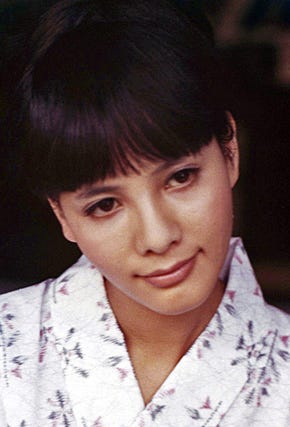
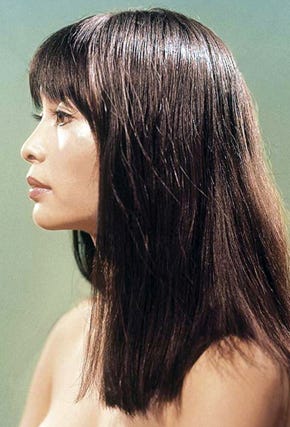
Of all the actresses who have appeared in the James Bond series, Japanese duo Mie Hama and Akiko Wakabayashi – who played Kissy Suzuki and Aki respectively in Lewis Gilbert’s 1967 epic You Only Live Twice – are undisputedly the most enigmatic and low profile.
Today a lucrative convention and autograph industry has been built up surrounding actors and actresses who have played roles – both large and sometimes surprisingly small – in pop culture classics such as the 007 films, but you won’t ever see Hama or Wakabayashi sat at a table meeting and greeting fans, posing for snaps and selling their autographs.
Post-007, neither actress ever appeared in a ‘western’ film again and – so far as I can tell – they have granted just one English-language interview each since 1967 – Wakabayashi having given a (translated) Q&A to Armand Vaquer and Brett Homenick of the Godzilla magazine G-Fan in 2006, while Hama granted an interview to the New York Times in March 2017.
In many ways Hama’s and Wakabayashi’s resolutely low profile intriguingly parallels the fate of Ian Fleming’s fictional creation Kissy Suzuki, who in the original novel YOU ONLY LIVE TWICE rejects Hollywood and instead returns to her home in Japan, settling for a quiet existence as an Ama diving girl. Thereafter, she is referred to by the media, as reported to Bond himself by ‘Tiger’ Tanaka, as “The Japanese Garbo”.
Both actresses have led fascinating lives and careers; of the two, Hama is undoubtedly the more renowned in Japan. Born on 20 November 1943 in Tokyo, her family were poor, a factory producing cardboard they owned having burned down during World War II.
While working as a ‘bus girl’ checking tickets on the public transportation system, Hama was talent spotted by film producer Tomoyuki Tanaka, who worked at the legendary Toho Studios and was one the original co-creators of Godzilla – alongside Shigeru Kayama, Ishiro Honda, Takeo Murata and Eiji Tsuburaya.
After making her movie debut in 1960, Hama became a well-known and regarded actress on the Japanese movie circuit, appearing in dozens of films throughout the decade which ran the full gamut of genres, from comedy to domestic drama and horror, including several appearances in the popular ‘Crazy Cats’ comedies and an appearance in critically acclaimed director Mikio Naruse’s 1964 film Yearning.
However it was Hama’s iconic appearances in cult genre classics such as King Kong vs. Godzilla (1962) and King Kong Escapes (1967) that made the biggest splash. By the time she was cast in You Only Live Twice Hama was a highly recognisable face in Japan, having appeared in around 60 films, often in leading roles, as well as appearing on posters for many of these films and being one of the most photographed actresses in the country.
The elder of the two actresses, Wakabayashi was born on 26 August 1939 or 1941, depending on which sources you consult, and had a similar, albeit more low profile, career compared to her fellow actress. In 2006, she explained to Vaquer and Homenick how she broke into the film industry:
“Girls were sought to play major female roles in Akira Kurosawa’s Hidden Fortress and Senkichi Taniguchi’s Uminari (its production was cancelled). I applied for the role with a friend from senior high school. It turned out to be the opportunity to join Toho as one of five girls selected from among more than 3,000 applicants.”
A regular in Toho Studios productions from 1958 onwards, Wakabayashi’s debut appears to have come in a supporting role in Ishiro Honda’s 1958 A Song For A Bride. An early lead role was in the Italian film Akiko, an interesting oddity in which she played a young Japanese woman born out of wedlock to an Italian soldier during World War II, who then visits his widow in Rome. As in You Only Live Twice, Wakabayashi’s character was given the same first name as her own.
Generally, Wakabayashi’s roles – which more often than not were supporting appearances rather than lead roles – fell into three genres – monster movies, such as King Kong vs Godzilla, Dogora the Space Monster, and Ghidrah, the Three-Headed Monster; spy movies, often imitating the 007 films, such as the International Secret Police movies, and ‘salaryman’ comedies (a popular genre at the time, set in Japanese offices).
Prior to appearing together in You Only Live Twice, Hama and Wakabayashi appeared in two films together, Key of Keys, a 1965 International Secret Police picture that was later redubbed and reworked by Woody Allen into his 1966 spoof What’s Up, Tiger Lily?, and the 1962 Toho production King Kong vs Godzilla, the third film in the iconic Japanese monster franchise.
When EON Productions set about casting You Only Live Twice, Japanese actor Tetsuro Tamba – who had already worked for director Lewis Gilbert in 1964 drama The 7th Dawn – proved an important sounding board in selecting Hama and Wakabayashi for the two major ‘Bond girl’ roles in Roald Dahl’s screenplay – Ama diving girl Kissy Suzuki and Japanese secret service agent Suki (as the character was originally named).
Subsequently, Tamba was also cast in the film as Tiger Tanaka, a role originally offered and refused by Toshiro Mifune, an actor renowned for his collaborations with legendary Japanese helmer Akiro Kurosawa, who instead opted to appear in John Frankenheimer’s motor racing drama Grand Prix.
Tamba apparently recommended Hama and Wakabayashi because he felt they would pick up English pretty quickly, as well as for their photogenic qualities.
However Hama, who had often agonised during her years in Japanese cinema about whether to remain in showbusiness, soon struggled with the attention that being a part of the 007 franchise entailed.
“I had never seen a 007 movie, and had no idea 007 was such a huge international hit,” she later told the New York Times, revealing that a member of the studio and production team told her on her arrival in London: “You’re a Bond girl now. The clothes you wear, the jewellery you put on, we will manage all of that.”
“Everything from my weight to the height of my heels was decided,” Hama added. “It may have looked glamorous, but for me, it was all a huge ordeal.”
These comments echo Hama’s words which appeared in press materials when You Only Live Twice was originally released: “I was simply terrified when I was first given the part – the Bond films are the most popular ever to play in Japan and all my friends told me that the eyes of the world were upon me. Suddenly I’m on my way to England to appear with Sean Connery in utter strange surroundings.”
Today, it is almost impossible to imagine the attention that must have been lavished on Hama and Wakabayashi when they were cast as Bond girls.
When You Only Live Twice was in pre-production, Bond-mania was at its height, while Japanese actors and actresses, indeed Japanese culture as a whole, had enjoyed comparatively little exposure in major Hollywood films. Toshiro Mifune was a familiar face in Hollywood, and the likes of Eiji Okada had also made some impact in the West, while Frank Sinatra’s 1965 film None But the Brave – a co-production between Warner Brothers and Toho – used several Japanese actors – however the 007 series’ incursion into Japan represented a whole new level of exposure and media attention for the local actors and actresses involved.
Then, as today, Hama emphasised the support and kindness that was shown to her by Sean Connery as she dealt with her new-found fame. “I am grateful to him for his kindness,” she said in 1967. “Although I only understood a few words of what he said I didn’t need language to appreciate his charming manner.”
To the New York Times in 2017 she added: “Every morning, he [Connery] asked if I was having any trouble. He also had a tough life before becoming a star, so he understood me.”
Adding to Hama’s unhappiness during the production of You Only Live Twice was the fact that she struggled to pick up English. According to director Lewis Gilbert this led to an unexpectedly dramatic situation.
His account of Hama and Wakabayashi’s casting appeared in his 2010 memoirs All My Flashbacks:
“Two actresses were chosen after that day’s work in the studio, Akiko Wakabayashi and Mie Hama. Neither spoke English. The best thing we could do for them, we thought, was send them to live with two English families where there were children. Conversation would be non-stop and simple. For three months the two actresses stayed in England, at the end of which we made another test, this time in English. My old writing colleague Vernon Harris, an ex-actor, cued them in. Akiko was fine. She could not only say the words, she could make sense of them. Mie was another matter. The three months had evidently been a struggle for her. Firstly, she couldn’t understand me, and when she spoke she was incomprehensible. She could make no sense of the dialogue at all. As shooting of the film was soon to start we were facing a big problem.
I went to Cubby and Harry to explain the hopelessness of the Mie situation. She would have to go home. “Yes, but how do we tell her?” they said. It was going to need delicate handling and none of us spoke Japanese. My suggestion was to ask Tetsuro Tamba. It was the only way out. He was with us in London and he could talk to Mie.
“Good idea, good idea,” said Harry and Cubby, relieved to be shot of the problem, not that it was a problem Tamba wanted either. “That’s serious, very serious,” he said.
“But could you not explain to Mie that it would do her no good to give a bad performance in a Bond film? It would be bad for us and bad for her,” I said.
“I’ll take her to dinner,” said Tamba. “I don’t know what I can do but I’ll try.”
The next morning, I rushed in to see him. What had happened? “Straight to the point,” said Tamba, “if you insist Mie goes back, tonight she will jump out of her window at The Dorchester Hotel and commit suicide.”
“What!” I said, “You’re joking.”
“No,” said Tamba, “you have to understand face-saving in Japan. It is most important. You have a girl who has been sent to England to be in the biggest film ever made in Japan and everybody in her country knows. If you send her back, you are saying she is no good. So, for her, the only way to save face is to commit suicide.”
This was indeed serious, and it was not up to me to make a decision off my own bat. The producers had to be told.
“What happened with Mie? What did she say?” asked Harry and Cubby when I went to see them.
“Sit down,” I said. “The news is not good.” Actually I was quite enjoying myself. The two of them were always dumping problems in my lap. Now it was my turn to dump a problem in theirs. I told them of Mie’s threat to jump out of her window at The Dorchester, concluding with, “It would make a splash in England and an even bigger splash in Japan,” which I thought was rather funny. Cubby and Harry did not.
“What shall we do?” they asked.
“If Mie does what she says she will do,” I answered, “that’s the end of the film because you’ll never get to make it in Japan and you can’t make it anywhere else. It’s that simple. So, we keep her and either carry on in the hope that her English improves or we revoice her at the end of the shoot and live with it.”
In the event, several months later, the latter is what happened. Skilled voice artiste Nikki van der Zyl, who had revoiced other Bond girls, listened to a Japanese speaking English and came up with an accent that sounded Japanese but had useful inflections.”
What Gilbert does not mention, is that the roles earmarked for Hama and Wakabayashi were also switched to make the filmmakers’ post-synching easier – with Akiko taking on the more dialogue heavy role of Suki (which was then renamed Aki) and Hama shifted to the role of Kissy.
Hama herself has never spoken about Gilbert’s claim, although Wakabayashi did briefly give Vaquer and Homenick her recollections of the casting switch:
“Of course it was the director’s decision. I was given the role of Kissy after an interview and a screen test in Japan (though it was a temporary decision). But when we read through the script in London, the roles were switched round. The name of the role was originally Suki, but it was changed to Aki as it sounded close to my name.”
Ultimately, Hama’s struggles with English led to her being revoiced, while Wakabayashi’s voice performance, remarkably – given the fact she spoke no English when originally cast, and given how often other 60s Bond girls were dubbed – made it to the final cut.
Like Hama, Wakabayashi spoke fondly of co-star Connery, telling Vaquer and Homenick: “James Bond in the movie is a ladies’ man, but Sean-san is a warm-hearted, honest man.
He has a clear vision as an actor. He can be stubborn from time to time, but he is a real man with a bit of old-fashioned taste.”
Post-007, both women’s careers assumed a far lower profile. In Hama’s case this was certainly a deliberate decision. Although she appeared in several more movies and TV series, notably as the Bondian ‘bad girl’ Madame Piranha in King Kong Escapes, she ultimately turned her back on acting and her contract with Toho in order to marry, have a family and reinvent herself as a writer and broadcaster who advocates a return to, and the preservation of, traditional Japanese customs and lifestyles.
“It was an honour to be a Bond girl, but once was enough,” the then 73-year-old Hama told the New York Times. “I didn’t want that image to stick with me. I am actually a subdued and steady person, but I felt that somewhere beyond my control, others were creating a character named ‘Mie Hama.’”
“Japan was giving up its real self in its rush for economic development. I realised that Japan had to get back to its real self. And so did I.”
Now living near Mount Fuji, all the mementoes that Hama has of her dalliance with ‘Bond-mania’ are now stored in her basement.
As for Wakabayashi, her list of post-You Only Live Twice credits extends to just one film and one TV series – a consequence, it appears, of injury, as well as the desire for a quieter life.
“I had injuries in some movies and TV shows,” she told Vaquer and Homenick. “Some bones suffered damage. It didn’t look serious because nobody saw anything from outside, but it was very painful. Now I enjoy a slow-paced life while helping my partner (an actor). I want more of a simple and slow-paced life.”
When this writer travelled to Japan in 2013 I hoped to track down both women and interview them for 007 MAGAZINE about their lives and careers pre and post-007, as well as hear their insights about their experiences filming You Only Live Twice and dealing with the maelstrom of media attention that followed, the 60s spy craze and Bond-mania.
Having interviewed, with few obstacles and wholehearted co-operation, many actresses from the world of 007 already – including Luciana Paluzzi, Shirley Eaton, Martine Beswicke, Margaret Nolan and Caroline Munro – I was perhaps naïve in thinking that I could add Hama and Wakabayashi to this illustrious roll call.
Prior to arriving in Japan I failed to find so much as a single contact that could pass on an interview request to Wakabayashi, whose whereabouts seemed a complete mystery to any one I talked to within the 007 industry and fan community.
As for Hama, I was able to make a request, via an email address on her personal website, for an interview, only to be informed by one of her managers, Shin Kaneko (also her son), that during the days I was in Tokyo and Kyoto she would be on summer vacation in Okinawa.
In typically polite Japanese fashion Kaneko told me “we appreciate your interest”, but my follow-up suggestion of an email interview went unanswered.
One man who I later discovered had met both women was former Bond continuation author Raymond Benson, during a research visit to Japan in 2001.
When I contacted Benson he informed me that he no longer had any way of contacting either woman. He was also kind enough to share his memories of meeting the two ladies with 007 MAGAZINE, telling me via email:
“I met both Akiko Wakabayashi and Mie Hama in the year 2001 when I was in Japan researching my [sixth] Bond novel, THE MAN WITH THE RED TATTOO.”
“The meetings were arranged by a mutual acquaintance in Japan. Ms. Wakabayashi was very pleasant; my guide and I spent a couple of hours talking with her about her career and experience on You Only Live Twice. We met at a restaurant, if I remember correctly, and then we took a stroll through a park. She had retreated from the public eye many years earlier and was enjoying her anonymity.
“Ms. Hama was very gracious and invited me and my guide to dinner at her house. She was very friendly and talkative, and the dinner she served – Italian! – was on the menu of her personal ‘restaurant’ that was a part of her home. Patrons had to make reservations to dine there, and she served only a small party at a time. She, too, talked about her experience on the Bond film, but as you know, she had a long career in Japan afterwards as a film star, television personality, and author. Both ladies were still beautiful.”
As Benson’s account suggests, both ladies prefer to largely keep their own counsel and remain detached from the media circus that often surrounds the Bond movies and the treadmill of conventions and autograph shows.
The full reasons for their decisions, of course, remain private and truly known only to Hama and Wakabayashi themselves.
Over the years, from many different sources here and in Japan, I have heard various rumours – for example, that both women have been ‘burned’ by their experiences with previous autograph hunters, fans and journalists.
Others have theorised that, like many artists connected with the Bond series, they have found the interest the films generate, and the long shadow involvement with 007 casts, to be somewhat disorientating.
An interesting further perspective was provided in a 2014 interview by Brett Homenick with Japanese actor Tatsuyoshi Ehara, who appeared in several ‘Toho’ films with Mie Hama.
“I sometimes see [former co-stars] Ms. Yuriko Hoshi and Ms. Nami Tamura, but I never see Ms. Hama,” he recalled. “I worked with Ms. Hama on three movies, and we went on location in Oshima for a commercial.
“She used to be a bus girl, and she was scouted for Toho and joined the studio, but being an actress was just one step in her life. So, after she got married and lived in the countryside, she never made public appearances.
“She was famous for her role in a 007 movie, but in those days people had a prejudice against that kind of movie. The actresses in those films were almost naked, so it was almost like a Nikkatsu role. Some people said she should have gone into Nikkatsu. Nikkatsu specialized in a certain genre, and Nikkatsu sounds like “nikku katsu,” and “niku” is “meat” or “body”!”
Given the Japanese tendency towards public prudishness, and the two ladies’ appearance in the 1967 PLAYBOY pictorial 007’s Oriental Eyefuls (albeit pretty modest appearances), it would be understandable if Hama and Wakabayashi perhaps regard their decorative status in a 007 film as somewhat embarrassing.
In the final analysis, though, such speculation is somewhat pointless. During the long research and gestation period of writing this article, I came to the realisation that Bond fans often treat the 007 films as their own personal property, and this sense of propriety often extends to those artists who were involved with the films, both in front of and behind the cameras.
Many fans seem to harbour the view that those involved in the Bond films have some form of ‘responsibility’ to the fans or the series in terms of making themselves available for interviews, conventions, autographs or photo opportunities.
I would now argue the opposite case. If someone is appearing at a convention or an autograph show then clearly they have decided to engage with the rules of the ‘fan game’, but I think it should be emphasised that this should always be a matter of personal choice.
The opposing choice, and wishes, of more private artists, such as Hama and Wakabayashi should also be respected.
Although she recorded a pair of DVD commentaries in Japan in 2001 and 2005, Akiko Wakabayashi has made no further public comment on her career since she told Vaquer and Homenick in 2006:
“I am very grateful to those who remain to be my fans long after I retired. I love movies because they amuse me and make me think about many things. I’m interested in staff as well as cast. Movies, both old and new, are my friends in life.”
As for Mie Hama, feeling somewhat guilty for my impudent Western persistence, I made one further effort to interview her, receiving this reply from Shin Kaneko, which for me brought a sense of closure to the matter:
“I sincerely thank your offer again. Both Mie and I realise that this year is a big year for You Only Live Twice. Mie told me that she ended her career as an actress more than 30 years ago and now she wants to keep that good memory as a Bond girl in her mind. She’s 73 years old now and she’s trying to keep a distance from the mainstream of the movie industry and enjoying her quiet life in suburb area of Japan. Therefore, I’m sorry but I may have to decline your offer. Truly sorry for that.”
“I told your request to her and she sincerely thanks [you] for that. But I hope you’ll understand the situation and respect her decision.”
“Thank you again for all the support and long lasting love for the movie. She send her regards to you as well.”
Although Hama and Wakabayashi’s public comments and appearances have been few and far between, their place in Bond history is forever assured.
Ian Fleming’s Kissy Suzuki forsook life in Hollywood for a return to the island of Kuro – and in a case of life imitating art – Hama and Wakabayashi’s journey has also, it seems, concluded with them finding comfort and peace at home, in Japan.
As Matsuo Basho – the master of the Haiku - once observed: “Every day is a journey, and the journey itself is home.”
This article was written in 2017. Today Mie Hama is 82 and Akiki Wakabayashi is now 86.
Click here for a fully illustrated version of this article.
Click on this text to see and order from our range of collectible hardback books